
Chaitanya Mahaprabhu: The Advent of Gaudiya Vaishnavism and the Hare Krishna Movement
Explore the life of Chaitanya Mahaprabhu, the founder of Gaudiya Vaishnavism, and the profound spiritual legacy of the Hare Krishna movement and Sankirtan.
यह लेख अभी अंग्रेज़ी में उपलब्ध है। हिंदी अनुवाद के लिए नीचे बटन दबाएँ।
Introduction
The historical and scriptural context of his appearance is deeply rooted in the concept of 'Yuga Dharma.' According to the Puranas, as the Kali Yuga (the age of quarrel and hypocrisy) progressed, the methods for attaining spiritual liberation became increasingly difficult. Chaitanya Mahaprabhu introduced the 'Sankirtan movement'—the congregational chanting of the holy names—as the most effective and accessible path for all humanity, regardless of caste, creed, or social standing. This was a revolutionary departure from the complex Vedic rituals and strict social hierarchies that dominated much of the religious landscape of his time.
His teachings were centered on the principle of 'Achintya Bheda Abheda' (inconceivable simultaneous oneness and difference), a philosophical cornerstone of Gaudiya Vaishnavism. This doctrine explains that the individual soul (Jiva) is qualitatively one with the Supreme (Krishna) but quantitatively different, much like a drop of ocean water is the same in quality as the ocean but different in quantity. Through his ecstatic movements and intense devotion, Mahaprabhu demonstrated how a human being could experience the divine emotions of the Gopis of Vrindavan, thereby bridging the gap between the material and spiritual realms.
Legend and historical records, such as the 'Chaitanya Charitamrita' by Krishnadasa Kaviraja Goswami, describe his life in various stages: from his scholarly brilliance in Navadvipa to his divine madness in Vrindavan, and finally his period of deep meditative seclusion in Puri. His influence birthed the Six Goswamis of Vrindavan, who systematized the philosophy and literature that would eventually fuel the global expansion of the Hare Krishna movement in the 20th century through A.C. Bhaktivedanta Swami Prabhupada.
Significance
Philosophically, Mahaprabhu’s teachings provided a profound psychological and metaphysical framework for understanding divine love. By emphasizing 'Madhurya Rasa' (conjugal/sweet love) over 'Aisvarya Rasa' (majesty/awe), he invited devotees to approach God not with fear or distant reverence, but with the intimate, spontaneous affection of a lover or a close friend. This shift humanized the divine relationship and made the pursuit of God accessible to anyone capable of feeling emotion.
Socially, the movement was a precursor to many egalitarian movements in India. By teaching that the holy name is equal for everyone, Mahaprabhu challenged the rigid caste-based restrictions on spiritual knowledge. He emphasized that one's spiritual status is determined solely by their devotion (bhakti) and not by birth or social standing. This inclusive approach helped democratize spirituality, offering a path of dignity and salvation to the marginalized sections of society.
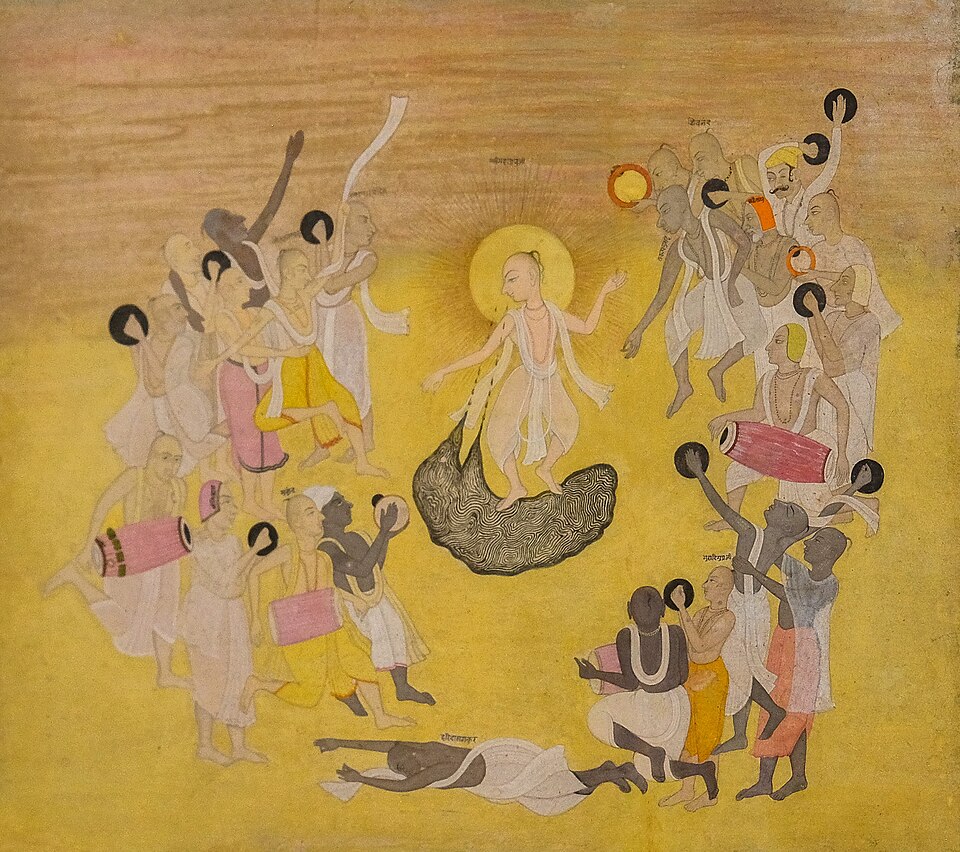
Culturally, the legacy of Mahaprabhu is etched into the music, dance, and literature of Bengal and across the world. The Kirtan tradition, characterized by rhythmic drumming (mridanga) and cymbal playing (karatals), has become a universal language of devotion. Today, the Hare Krishna movement (ISKCON) stands as a global testament to his mission, spreading the principles of vegetarianism, simple living, and high thinking, while fostering a global community centered around the chanting of the holy names.
Best Time to Recite
Find your exact auspicious time Check the shubh muhurat and choghadiya for your city and date.
How to Recite
- 1Begin by offering obeisances (Dandavat Pranam) to the Guru and the Deity.
- 2Light incense and a ghee lamp to sanctify the atmosphere.
- 3Engage in Japa meditation: Sit cross-legged and chant the Maha-mantra on Tulasi beads, focusing intensely on each syllable.
- 4Perform Sankirtan: Gather with others, use the Mridanga and Karatals, and chant the holy names loudly and rhythmically.
- 5Incorporate dance (Nritya) if the emotion of the chant inspires it, as Mahaprabhu often did.
- 6Conclude by offering food (Prasadam) to the Deity and then distributing it to all present.
Mantras
The Maha-mantra
हरे कृष्ण हरे कृष्ण कृष्ण कृष्ण हरे हरे। हरे राम हरे राम राम राम हरे हरे॥
Hare Kṛṣṇa Hare Kṛṣṇa Kṛṣṇa Kṛṣṇa Hare Hare | Hare Rāma Hare Rāma Rāma Rāma Hare Hare ||
Meaning: O Lord, O energy of the Lord, please engage me in Your loving service.
Do's
- ✓Chant with focus and sincere emotion.
- ✓Respect the holy name as being non-different from the Divine.
- ✓Engage in hearing (Shravanam) spiritual discourses.
- ✓Treat all living beings with compassion (Ahimsa).
Don'ts
- ✗Do not chant mechanically without attention.
- ✗Do not criticize other practitioners or paths (avoiding sectarianism).
- ✗Do not engage in gossip or harsh speech while in a spiritual mood.
- ✗Do not neglect physical cleanliness and hygiene.
Common Mistakes to Avoid
- •Treating the mantra as a mere magic spell rather than a call for relationship.
- •Focusing solely on the ritualistic aspect while neglecting the inner emotional devotion.
- •Attempting to bypass the need for a Guru or a spiritual lineage (Sampradaya).
Frequently Asked Questions
What is the core philosophy of Gaudiya Vaishnavism?▾
Why is Chaitanya Mahaprabhu called 'Golden Avatar'?▾
Is anyone allowed to chant the Hare Krishna mantra?▾
लोकप्रिय टूल
References & Traditional Notes
- •The teachings are primarily derived from the Chaitanya Charitamrita and Caitanya Bhagavata.
- •The practice of Japa should ideally be done on Tulasi beads for maximum spiritual benefit.
- •The concept of 'Bhakti' here is distinct from mere religious duty; it is a spontaneous emotional outpouring.
Related Audio & Bhajans
Om Jai Jagdish Hare
Aarti Kunj Bihari Ki - Krishna Aarti
Narada Geeta - Swami Divya Chaitanya ji (Varanasi)
Allahabad Prayagraj Triveni Sangam Kumbh Lord Shiva, Lord Krishna, Goddess Saraswati pilgrimage
ఉపనిషత్ ఉద్యానవనం - 108 ఉపనిషత్తులు - వాల్యూమ్ – 4 of 6 by యేలేశ్వరపు హనుమ రామకృష్ణ Upanishad Udyanavanam – 108 Upanishads Volume – 4 of 6 by Yeleswarapu Hanuma RamaKrishna
Adventure
DaltonClodfelter | NIGHT AT CAMP COZY! CHOOSE YOUR OWN ADVENTURE! DALTON'S HALLOWEEN SPECIAL!
फ्लिपकार्ट पर पूजा और त्योहारी सामग्री खरीदें
क्लिक करने पर हमारे एफ़िलिएट लिंक से फ्लिपकार्ट खुलता है। कीमत और उपलब्धता बदल सकती है।
फ्लिपकार्ट पर खरीदेंCueLinks प्रकाशक: 300371
मिंत्रा पर त्योहारी परिधान खरीदें
क्लिक करने पर हमारे एफ़िलिएट लिंक से मिंत्रा खुलता है। कीमत और उपलब्धता बदल सकती है।
CueLinks प्रकाशक: 300371