
Dakshinamurthy: Understanding Shiva as the Supreme Guru and Master of Silence
Explore the profound significance of Lord Dakshinamurthy, the primordial Guru of Shiva, representing the embodiment of supreme wisdom, silence, and moksha.
Next Guru Purnima
Sunday, 18 July 2027· in 273 days
Set a reminder so you never miss Guru Purnima.
Introduction
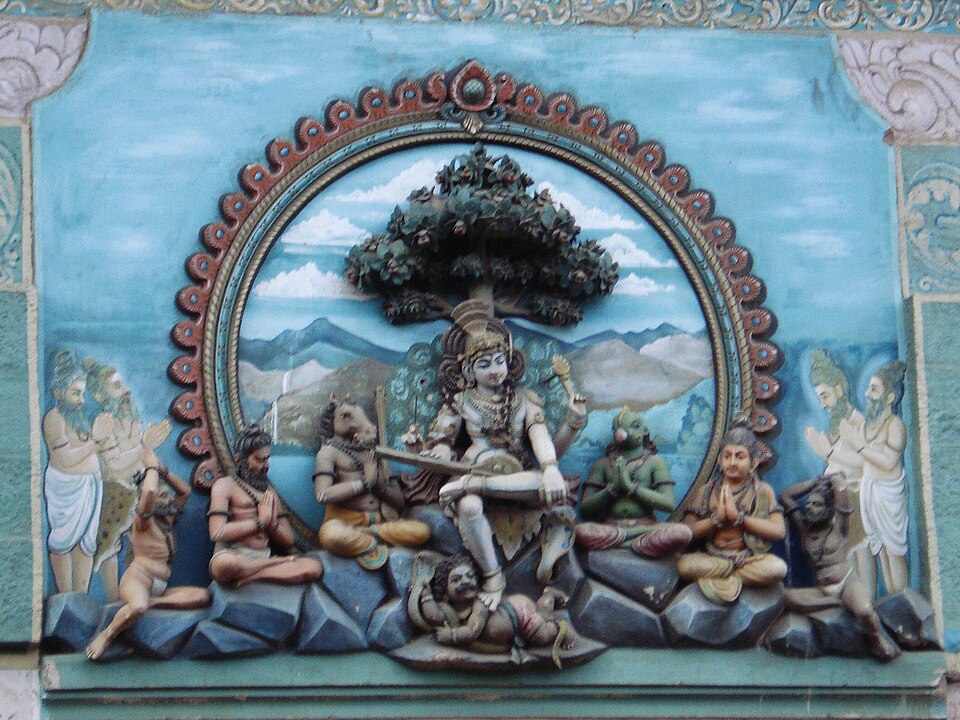
Scripturally, the iconography and essence of Dakshinamurthy are extensively detailed in the Agamas, the Upanishads, and various Puranas. He is often depicted as a youthful, handsome ascetic sitting under a sacred Banyan tree (Vata Vruksha). He is surrounded by sages (Rishis) who sit in rapt silence, receiving the highest truths not through spoken words, but through 'Mauna Vyakhyana'—the teaching through silence. This form emphasizes that the highest reality (Brahman) is beyond the limitations of language and logic; it can only be experienced through direct intuition and the stillness of the mind.
The legend of Dakshinamurthy often highlights the gathering of the four great sages—Sanaka, Sanatana, Sanandana, and Sanatkumara—who sought the ultimate truth. Shiva appeared in this form to satisfy their profound spiritual thirst. This manifestation serves as the foundation for the Guru-Shishya Parampara (the teacher-disciple lineage) that defines much of Indian spiritual history. Whether one follows Advaita Vedanta, Shaiva Siddhanta, or other paths, Dakshinamurthy remains the archetypal figure of the teacher who dissolves the ego and reveals the oneness of the Atman with the Brahman.
Culturally, the worship of Dakshinamurthy is central to many South Indian traditions and is deeply integrated into the daily lives of seekers. He is not merely a deity to be petitioned for material boons, but a presence to be meditated upon to cultivate intellect (Buddhi), discernment (Viveka), and mental clarity. His presence in temples, often situated in the southern sanctum or as a separate shrine, serves as a constant reminder that the path to liberation requires discipline, silence, and the grace of a true Guru.
Significance
Symbolically, every element of his iconography carries immense weight. The Banyan tree represents eternal life and the spreading of knowledge. The Vedas, often held in his hands, signify the authority of sacred truth. His right hand is frequently in the 'Jnana Mudra' (the gesture of wisdom), where the index finger (representing the individual soul) touches the thumb (representing the Supreme Soul), symbolizing the non-duality of the two. The fire in his hand signifies the burning away of worldly attachments and ego, while the rosary (Akshamala) represents the cyclic nature of time and the continuous repetition of sacred mantras.
In the context of daily life, Dakshinamurthy is invoked to sharpen the intellect and improve the ability to discern between the real and the unreal (Viveka). For students, scholars, and seekers of any discipline, he is the patron deity of learning. Devotees believe that regular contemplation of his form helps in overcoming mental confusion, anxiety, and the 'dark night of the soul.' It is believed that his grace can grant 'Siddhis' (spiritual powers), though the primary goal remains the realization of the Self.
Astrologically and traditionally, worship of Dakshinamurthy is often recommended during periods of confusion or when one seeks guidance in their spiritual journey. In many traditions, he is worshipped to mitigate the effects of malefic planets that cloud the intellect. The 'phala' or fruit of his worship is not wealth or power, but 'Atma-Jnana'—the profound, unshakeable knowledge of one's own divine nature, which remains steady amidst the changes of the world.
Best Time to Recite
Find your exact auspicious time Check the shubh muhurat and choghadiya for your city and date.
How to Recite
- 1Achamana: Take small sips of water while chanting names of Vishnu to purify the self.
- 2Sankalpa: Hold water and rice in your right hand and state your intention (Sankalpa) to perform the puja for wisdom and clarity.
- 3Deepa Prajwalana: Light the ghee lamp to invoke the presence of the divine light.
- 4Dhyana: Close your eyes and meditate on the form of Dakshinamurthy sitting under the Banyan tree, surrounded by silent sages.
- 5Abhisheka: If using an idol, gently pour water, milk, and then Panchamrita over the deity, following the traditional sequence.
- 6Alankara: Wipe the deity and apply Chandan (sandalwood) and Kumkum. Offer fresh flowers and Bilva leaves.
- 7Naivedyam: Offer the prepared fruits, sweets, or cooked food to the Lord.
- 8Mantra Japa: Recite the Dakshinamurthy Gayatri or the specified Beeja mantras with focus and devotion.
- 9Aarti: Perform the aarti with a camphor flame, circling it in a clockwise direction while singing hymns.
- 10Pradakshina and Shanti Path: Circumambulate your seat (if applicable) and conclude with a prayer for peace and the removal of ignorance.
Mantras
Dakshinamurthy Gayatri Mantra
ॐ तत्पुरुषाय विद्महे महादेवाय धीमहि तन्नो गुरुः प्रचोदयात् ॥
Om Tatpurushaya Vidmahe Mahadevaya Dhimahi Tanno Guruh Prachodayat
Meaning: Om, Let us meditate on the Supreme Being. May the Great God (Mahadeva) illumine our intellect. May that Guru guide us toward the truth.
Dakshinamurthy Moola Mantra
ॐ ऐं ह्रीं क्लीं दक्षिणामूर्तये नमः
Om Aim Hreem Kleem Dakshinamurtaye Namaha
Meaning: Om, Salutations to Lord Dakshinamurthy, the embodiment of wisdom, power, and attraction of truth.
Do's
- ✓Maintain mental stillness during meditation.
- ✓Show immense respect to your living teachers and gurus.
- ✓Use fresh and clean materials for the puja.
- ✓Approach the ritual with humility and a thirst for knowledge.
Don'ts
- ✗Do not perform the puja with a distracted or agitated mind.
- ✗Do not use stale or wilted flowers.
- ✗Avoid discussing trivial or negative topics during the ritual period.
- ✗Do not approach the deity with ego or the desire for worldly dominance.
Common Mistakes to Avoid
- •Focusing only on the physical rituals while neglecting internal meditation.
- •Misunderstanding the silence of Dakshinamurthy as mere emptiness rather than fullness.
- •Performing the mantra japa without proper pronunciation or understanding of the intent.
- •Neglecting the importance of a clean and peaceful environment.
Frequently Asked Questions
Why is Dakshinamurthy facing South?▾
Can students worship Dakshinamurthy?▾
What is the significance of the Banyan tree in his iconography?▾
Popular Tools
References & Traditional Notes
- •The Dakshinamurthy Stotram by Adi Shankaracharya is considered one of the most profound texts for understanding this deity.
- •Traditional practices suggest that the 'Mauna' (silence) practiced by the sages in his presence is a form of advanced yogic practice.
- •Consult the Shiva Purana for deeper mythological context regarding Shiva's various manifestations.
Related Audio & Bhajans
Dakshinamurthy Understanding Shiva Supreme Guru Lord Dakshinamurthy mantra
Shop Pooja & Festive Essentials on Flipkart
Clicking opens Flipkart via our affiliate link. Prices and availability may vary.
Shop on FlipkartCueLinks Publisher: 300371
Shop Festive Wear on Myntra
Clicking opens Myntra via our affiliate link. Prices and availability may vary.
CueLinks Publisher: 300371
Need a website? Describe it, and AI builds it.
Perfect for a temple, pooja service, astrology practice or small shop. Tell the AI what you want — or drag and drop the classic way — and go live on your own web address in minutes with Sitova. Hosting, SEO, forms and analytics are all included.
- Build with AI or drag & drop
- Your domain + SEO built in
- Free forever plan
Opens sitova.site