
Dattatreya — The Trinity Incarnation of Brahma Vishnu Shiva
Explore Lord Dattatreya, the unified incarnation of Brahma, Vishnu, and Shiva, his legends, symbolism, worship methods, mantras, and spiritual significance in Hindu tradition.
Affiliate disclosure: Sanatan Hindu participates in the Amazon Associates Programme and the CueLinks affiliate network (Myntra & Flipkart). This page contains affiliate links, if you click and buy, we earn a small commission at no extra cost to you. As an Amazon Associate we earn from qualifying purchases. Full disclosure.
Introduction
Significance
Best Time to Perform
Find your exact auspicious time Check the shubh muhurat and choghadiya for your city and date.
Required Samagri (Materials)
Preparation Steps
- 1Take a purificatory bath and wear clean, preferably white or yellow, clothing.
- 2Clean the puja area thoroughly; sprinkle Ganga jal to sanctify.
- 3Place the altar facing east or north; spread the cloth.
- 4Install the Dattatreya idol/picture on a raised platform; if using a photo, frame it respectfully.
- 5Arrange all samagri neatly within reach: flowers, sandalwood, incense, lamp, naivedya, water vessels.
- 6Light the ghee lamp and incense before beginning.
- 7Sit on your asana facing the deity; calm the mind with a few deep breaths.
- 8Invoke Lord Ganesha first (Vighneshwara) for obstacle-free worship.
- 9Mentally invite your guru and the guru parampara, offering pranams.
- 10Set a sankalpa (intention) for the puja: e.g., 'For spiritual progress, guru kripa, and removal of obstacles.'
Step-by-Step Vidhi
- 1Begin with achamana: sip water from the panchapatra three times, chanting 'Om Achyutaya Namah, Om Anantaya Namah, Om Govindaya Namah'.
- 2Perform pranayama: inhale through left nostril, retain, exhale through right; repeat 3 times to purify nadis.
- 3Do nyasa: touch forehead, heart, shoulders, etc., with mantras to invoke divine presence in the body (optional for advanced).
- 4Offer padya (water for washing feet), arghya (water for washing hands), achamana (water for sipping), and snana (bathing the deity with panchamrita followed by pure water).
- 5Wipe the idol gently with a clean cloth; apply sandalwood paste on the three foreheads and chest.
- 6Offer kumkum, haldi, and akshata (unbroken rice mixed with turmeric).
- 7Offer flowers and tulsi leaves at the feet and on the heads, chanting 'Om Dattatreyaya Namah' with each offering.
- 8Light the ghee lamp and wave it in circular motion (deeparadhana) while ringing the bell.
- 9Offer incense (dhupa) similarly.
- 10Present naivedya: place fruits, sweets, and panchamrita before the deity; offer with the mantra 'Om Pranaya Swaha, Om Apanaya Swaha, Om Vyanaya Swaha, Om Udanaya Swaha, Om Samanaya Swaha, Om Brahmane Swaha'.
- 11Perform aarti with camphor: sing Dattatreya Aarti (see mantras section) while waving the aarti plate.
- 12Blow the conch three times to disseminate the vibrations.
- 13Do pradakshina (circumambulation) three times clockwise around the altar (or mentally if space is limited).
- 14Offer namaskara (prostration) — sashtanga for men, panchanga for women — with humility.
- 15Distribute prasad to all present; partake yourself with gratitude.
- 16Conclude with shanti mantra: 'Om Shanti Shanti Shantih'.
- 17Meditate silently for 10–15 minutes, visualizing Dattatreya's form in the heart center.
Mantras
Dattatreya Moola Mantra
ॐ द्रां दत्तात्रेयाय नमः
Om Dram Dattatreyaya Namah
Meaning: Salutations to Dattatreya, the son of Atri, who bestows the highest truth. 'Dram' is the bija (seed) syllable invoking his grace.
Dattatreya Gayatri Mantra
ॐ दत्तात्रेयाय विद्महे अवधूताय धीमहि तन्नो दत्तः प्रचोदयात्
Om Dattatreyaya Vidmahe Avadhootaya Dhimahi Tanno Dattah Prachodayat
Meaning: We meditate on Dattatreya, the Avadhuta (liberated one). May he illumine our intellect and guide us to liberation.
Dattatreya Stotram (Opening Verse)
जटिलं मुनिरूपं त्रिगुणात्मनं त्रिनेत्रं त्रिशूलधारिणम्। दिगम्बरं सर्ववाहनं वरं तं दत्तात्रेयं प्रणमाम्यहम्॥
Jatilam Munirupam Trigunatmanam Trinetram Trishuladharinam. Digambaram Sarvavahanam Varam Tam Dattatreyam Pranamamyaham.
Meaning: I bow to Dattatreya, who wears matted locks, has the form of a sage, embodies the three gunas, has three eyes, holds the trident, is sky-clad (digambara), rides all vehicles, and is the supreme boon-giver.
Dattatreya Aarti (First Verse)
जय जय श्री गुरुदेव दत्तात्रेय। जय जय श्री गुरुदेव दत्तात्रेय॥ अवधूत चिंतामणि सद्गुरु दत्त। कमलासन ब्रह्मा विष्णु शिव स्वरूप॥
Jai Jai Shri Gurudev Dattatreya. Jai Jai Shri Gurudev Dattatreya. Avadhuta Chintamani Sadguru Datta. Kamalasan Brahma Vishnu Shiva Swarup.
Meaning: Victory to Shri Guru Dev Dattatreya! You are the wish-fulfilling gem of the Avadhutas, the true Guru Datta. You are the very form of Brahma (lotus-seated), Vishnu, and Shiva.
Guru Dattatreya Dhyana Shloka
इन्द्रियाणां मनो बुद्धिः सत्त्वं तेजो बलं क्षमा। दत्तात्रेयोऽवतारेण सर्वेषां गुरुरुच्यते॥
Indriyanam Mano Buddhi Sattvam Tejo Balam Kshama. Dattatreyo Avataren Sarvesham Gurur Uchyate.
Meaning: He who is the master of the senses, mind, intellect, purity, radiance, strength, and forgiveness — Dattatreya is declared the guru of all in his incarnation.
Do's
- ✓Approach Dattatreya with humility and surrender (sharanagati).
- ✓Maintain regularity in daily worship, even if brief.
- ✓Respect all gurus and the guru parampara; see Dattatreya in every teacher.
- ✓Practice selfless service (seva) as worship of the Lord in all beings.
- ✓Study his teachings in Avadhuta Gita, Jivanmukta Gita, and Tripura Rahasya.
- ✓Feed cows, dogs, and birds — they are his symbolic companions.
- ✓Observe silence and introspection on Thursdays.
- ✓Wear rudraksha (especially 1-mukhi, 3-mukhi, or 14-mukhi) for connection.
- ✓Visit Dattatreya temples (Gangapur, Narasimha Wadi, Pithapuram, Mahur) when possible.
- ✓Cultivate detachment (vairagya) and discrimination (viveka) in daily life.
Don'ts
- ✗Do not treat Dattatreya worship as mere ritual without inner devotion.
- ✗Avoid consuming alcohol, meat, onion, garlic on worship days (especially Thursday).
- ✗Do not disrespect the guru, elders, or sacred texts.
- ✗Never use the mantra or his name for material gain, black magic, or harming others.
- ✗Avoid criticizing other deities or traditions; Dattatreya embodies unity.
- ✗Do not skip the guru's instructions if you have taken diksha.
- ✗Refrain from gossip, lying, and anger during vrat periods.
- ✗Do not offer stale or unoffered food as naivedya.
- ✗Avoid wearing black or dirty clothes during puja.
- ✗Do not touch the idol with unwashed hands or during menstruation (as per family tradition).
Common Mistakes to Avoid
- •Confusing Dattatreya with only one deity (e.g., only Shiva or only Vishnu) — he is the unity of all three.
- •Pronouncing mantras incorrectly without learning from a qualified guru.
- •Performing puja mechanically without bhava (feeling) and shraddha (faith).
- •Neglecting the guru principle: Dattatreya is the guru; ignoring living gurus contradicts his teaching.
- •Focusing only on material benefits (siddhis) rather than self-knowledge.
- •Imitating the external Avadhuta lifestyle (nakedness, unconventional behavior) without inner realization.
- •Skipping the sankalpa (intention) before puja.
- •Using non-vegetarian offerings or intoxicants in worship — strictly prohibited.
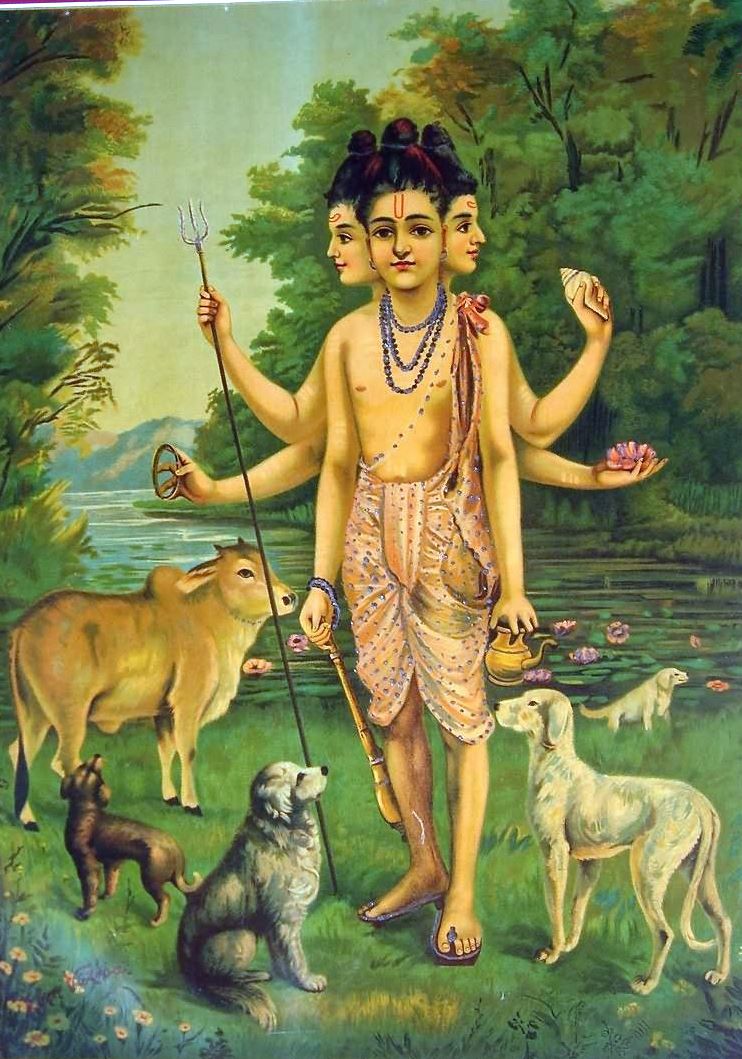
- •Ignoring the four dogs and cow in iconography — they are integral to his symbolism.
- •Believing Dattatreya worship is restricted to a particular caste, region, or gender — it is universal.
Regional Variations
- •Maharashtra: Strong Guru Charitra tradition; Thursday vrat widely observed; major temples at Gangapur, Narasimha Wadi, Audumbar, Karanja. Dattatreya Jayanti celebrated with palkhi processions.
- •Karnataka: Narasimha Wadi (Kuruvapur) is a key kshetra; Dattatreya worship integrated with Veerashaiva and Madhwa traditions; emphasis on Guru Paduka puja.
- •Andhra Pradesh/Telangana: Pithapuram (Dattatreya as Sri Pada Vallabha) and Srisailam are major centers; Sri Pada Sri Vallabha Charitamrutam is the key text.
- •Gujarat: Dattatreya worshipped as part of Nath and Vaishnava traditions; temples in Girnar, Ahmedabad; emphasis on Avadhuta Gita study.
- •North India: Revered in Nath Sampradaya (Gorakhnath lineage); associated with yogic practices; temples in Varanasi, Haridwar, Mount Abu.
- •Tamil Nadu/Kerala: Worshipped as Avadhuta and Siddha; linked to 18 Siddhars; temples in Tiruvannamalai, Courtallam; emphasis on Jnana and yoga.
- •Goa: Unique syncretic tradition with Christian influences in some families; Dattatreya as 'Devchar' in folk tradition.
- •Nepal: Dattatreya temple in Bhaktapur (15th century); worshipped with Tantric rituals; three-tiered pagoda structure.
Frequently Asked Questions
Is Dattatreya a historical figure or a mythological deity?▾
Why does Dattatreya have three heads and six arms?▾
Can women worship Dattatreya? Are there restrictions?▾
What is the significance of the four dogs and the cow with Dattatreya?▾
Do I need a guru to worship Dattatreya or chant his mantras?▾
What is the Guru Charitra and why is it important?▾
How is Dattatreya related to the Nath tradition and yoga?▾
Can Dattatreya be worshipped at home without a temple visit?▾
Popular Tools
References & Traditional Notes
- •Bhagavata Purana (Canto 1, Chapter 3; Canto 11, Chapters 7–9) — describes Dattatreya's birth and teachings as an Avadhuta.
- •Markandeya Purana (Chapters 36–43) — detailed account of Anasuya's test and the Trimurti's boon.
- •Brahmanda Purana — Dattatreya as incarnation of Trimurti.
- •Dattatreya Upanishad (Atharvaveda) — mantras, vidya, and meditation on Dattatreya.
- •Avadhuta Gita — attributed to Dattatreya; highest Advaita teaching.
- •Jivanmukta Gita — on the state of liberation while living.
- •Tripura Rahasya (Jnana Khanda) — dialogue between Dattatreya and Parashurama on non-duality.
- •Guru Charitra (Shri Guru Charitra) by Saraswati Gangadhar (15th century) — life of Shripad Shrivallabha and Narasimha Saraswati.
- •Sri Pada Sri Vallabha Charitamrutam — Telugu text on the first avatar of Dattatreya in Kali Yuga.
- •Nath Sampradaya texts: Siddha Siddhanta Paddhati, Goraksha Samhita — Dattatreya as Adi Nath.
- •Skanda Purana (Dattatreya Mahatmya) — glories of Dattatreya kshetra Mahur.
- •Traditional note: Practices vary by sampradaya (Nath, Madhwa, Smarta, Tantric). Always follow your guru's instructions.
Related Audio & Bhajans
Pooja & Patola
Affiliate disclosure: Sanatan Hindu participates in the Amazon Associates Programme and the CueLinks affiliate network (Myntra & Flipkart). This page contains affiliate links, if you click and buy, we earn a small commission at no extra cost to you. As an Amazon Associate we earn from qualifying purchases. Full disclosure.
Shop Samagri on Amazon.in
Clicking opens Amazon.in. Prices and availability may vary.
Browse all pooja itemsAmazon Associates tag: geekydevelope-21
Shop Pooja & Festive Essentials on Flipkart
Clicking opens Flipkart via our affiliate link. Prices and availability may vary.
Shop on FlipkartCueLinks Publisher: 300371
Shop Festive Wear on Myntra
Clicking opens Myntra via our affiliate link. Prices and availability may vary.
CueLinks Publisher: 300371
Need a website? Describe it, and AI builds it.
Perfect for a temple, pooja service, astrology practice or small shop. Tell the AI what you want — or drag and drop the classic way — and go live on your own web address in minutes with Sitova. Hosting, SEO, forms and analytics are all included.
- Build with AI or drag & drop
- Your domain + SEO built in
- Free forever plan
Opens sitova.site