Sacred PlacesKhandoba (Martanda Bhairava)Bhandara Festival

Jejuri Khandoba Temple: A Divine Guide to History, Legends, and the Bhandara Festival

Explore the sacred Jejuri Khandoba Temple, the legendary history of Lord Martanda Bhairava, and the spiritual significance of the golden Bhandara festival.
By Sanatan Hindu4 min readUpdated 1 August 2026Audio available
Share:

Affiliate disclosure: Sanatan Hindu participates in the Amazon Associates Programme and the CueLinks affiliate network (Myntra & Flipkart). This page contains affiliate links, if you click and buy, we earn a small commission at no extra cost to you. As an Amazon Associate we earn from qualifying purchases. Full disclosure.

Jejuri Khandoba Temple: A Divine Guide to History, Legends, and the Bhandara Festival

Introduction

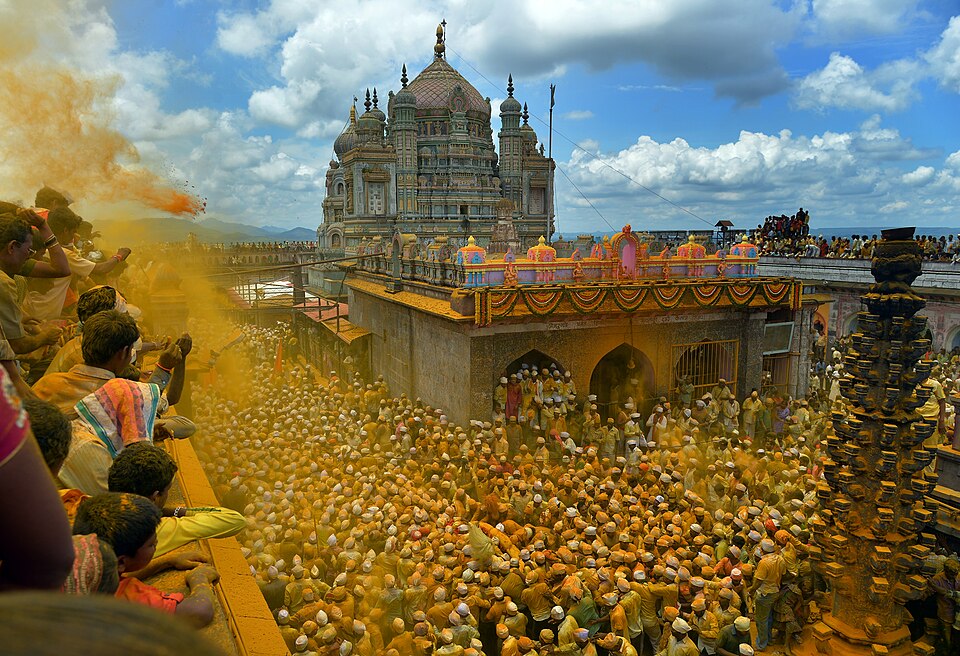
Perched atop the hills of Jejuri in the Pune district of Maharashtra, the temple of Lord Khandoba stands as a monumental beacon of devotion, courage, and divine protection. Khandoba, an avatar of Lord Shiva, is worshipped as Martanda Bhairava—the solar aspect of the destroyer of darkness. The temple complex, characterized by its golden hues and the rhythmic chants of 'Yelkot Yelkot Jai Malhar,' serves as a spiritual epicenter for millions of devotees, particularly from the Maratha and various farming communities, though its grace extends to all who seek refuge in the Divine.
The origins of the temple are deeply intertwined with Puranic legends. According to sacred texts, Lord Shiva took the form of Khandoba to slay the demon Mani and Malla, who had terrorized the heavens and the earth. This victory of good over evil is not merely a historical myth but a spiritual metaphor for the triumph of consciousness over the ego and ignorance. The deity is often depicted with a sword, riding a horse, embodying the qualities of a protector and a warrior-saint. The temple itself is believed to have been established through the spiritual energy of various saints and through the divine will of the Lord himself.
Historically, the temple has been a site of immense cultural importance, reflecting the socio-political landscape of Maharashtra. It is closely associated with the folk traditions of the Deccan plateau, where the worship of 'Kuladevata' (family deities) is deeply ingrained in the social fabric. The temple's architecture, while evolving over centuries, maintains a sense of antiquity and sanctity that transports the pilgrim back to a primordial era of Vedic and Puranic traditions. The atmosphere is perpetually charged with the scent of turmeric and the echoes of dhol-tasha drums.
For a newcomer, understanding Jejuri requires looking beyond the physical structure. It is an experience of 'Bhakti' (devotion) in its most visceral form. The temple is not just a place of prayer but a living, breathing tradition where the boundaries between the human and the divine blur through the medium of the 'Bhandara' (turmeric powder). This sacred yellow powder represents the brilliance of the sun and the divine light that illuminates the path of the seeker, making Jejuri a destination of profound transformation and spiritual awakening.

Significance

The significance of the Jejuri Khandoba Temple is multifaceted, spanning the spiritual, social, and psychological realms. Spiritually, Khandoba is revered as a protector deity who provides 'Abhaya' (fearlessness) to his devotees. By worshipping Martanda Bhairava, devotees seek the strength to overcome internal demons—lust, anger, and greed—just as the Lord overcame the demons Mani and Malla. The presence of the deity at Jejuri is believed to be 'Swayambhu' or divinely manifested, making the site a 'Tirtha' (a holy crossing point) where the veil between the physical and spiritual worlds is thin.
The most striking feature of the Jejuri tradition is the use of 'Bhandara' (haldi/turmeric). In Hindu symbolism, yellow is the color of knowledge, learning, and the sun. The act of showering turmeric on the deity and, subsequently, on each other, symbolizes the spreading of divine light and the dissolution of the ego. It is a visual representation of 'Tejas' (radiance). When a devotee is covered in gold-colored turmeric, they are metaphorically being bathed in the grace of the Sun God, Martanda, which purifies the soul and brings prosperity.
Culturally, the temple serves as a unifying force. The Bhandara festival and the daily rituals transcend caste and class boundaries, fostering a sense of communal harmony. The 'Yelkot Yelkot Jai Malhar' chant acts as a collective mantra that synchronizes the heartbeat of the crowd, creating a shared spiritual identity. This communal aspect is vital in the context of Indian village life, where the Kuladevata acts as the spiritual guardian of the entire community's well-being.
Astrologically and seasonally, the visits to Jejuri often coincide with auspicious periods that align with the solar cycles, reflecting the deity's identity as a solar aspect of Shiva. The blessings received here are believed to mitigate the malefic effects of planetary alignments and provide stability in one's professional and domestic life. For many, a pilgrimage to Jejuri is a rite of passage, a way to seek divine sanction for new beginnings, marriages, or the protection of children.

When to Celebrate

The most auspicious time to visit is during the Bhandara Festival (usually around Mahashivratri or specific lunar cycles) and during the month of Chaitra. For daily worship, early morning (Brahma Muhurta) is considered most potent.

Find your exact auspicious time Check the shubh muhurat and choghadiya for your city and date.

What You'll Need

Bhandara (Pure Turmeric powder)
Flowers (specifically Marigold)
Incense sticks (Agarbatti)
Oil lamp (Diya) with Ghee
Fruits (Banana, Pomegranate)
Coconut
Sandalwood paste
Bel leaves (Bilva Patra)

How to Prepare

  1. 1Perform physical purification with a bath before heading to the temple.
  2. 2Wear clean, preferably traditional clothing (Dhoti or Saree).
  3. 3Ensure a calm and meditative mindset, focusing on the form of Martanda Bhairava.
  4. 4If visiting during a festival, prepare a mental list of prayers or 'Sankalpa' (intentions).

How to Celebrate

  1. 1Approach the temple entrance and offer a respectful bow to the threshold.
  2. 2Perform 'Pradakshina' (circumambulation) of the sanctum sanctorum in a clockwise direction.
  3. 3Offer the 'Bhandara' (turmeric) to the deity, symbolizing the offering of one's own light and ego.
  4. 4Light the Ghee Diya to signify the removal of darkness from the intellect.
  5. 5Recite the 'Jai Malhar' chant or specific Khandoba mantras with devotion.
  6. 6Receive the 'Prasad' (blessed turmeric) and apply it to your forehead as a mark of protection.
  7. 7Sit in silence for a few moments to absorb the 'Shakti' (energy) of the temple.

Mantras

Khandoba Moola Mantra

ॐ ह्रीं मल्हार्यै नमः

Om Hreem Malharyai Namah

Meaning: Salutations to the Lord who is the destroyer of Mani and Malla.

Martanda Bhairava Chant

मल्हारी मल्हार, येलकोट येलकोट जय मल्हार

Malhari Malhar, Yelkot Yelkot Jai Malhar

Meaning: Victory to Malhar, the destroyer of demons, Glory to the Lord Malhar!

Observance Rules

  • Maintain celibacy (Brahmacharya) during the period of pilgrimage.
  • Follow a Satvic diet (no onion, garlic, or non-vegetarian food).
  • Avoid anger and harsh speech during the visit.
  • Observe silence (Mauna) during specific ritual timings if possible.

Do's

  • Apply turmeric (Bhandara) to the deity and yourself.
  • Chant 'Jai Malhar' with full conviction.
  • Participate in the community prayers.
  • Offer flowers and fresh fruits.

Don'ts

  • Do not enter the sanctum in a state of impurity.
  • Do not use non-edible or adulterated turmeric for the deity.
  • Avoid taking photographs inside the inner sanctum where prohibited.
  • Do not engage in loud, unnecessary arguments within the temple premises.

Common Mistakes to Avoid

  • Treating the pilgrimage as a mere tourist excursion rather than a spiritual journey.
  • Using low-quality turmeric that might contain dyes.
  • Neglecting the importance of 'Sankalpa' (setting an intention) before prayer.
  • Ignoring the traditional dress code which shows respect to the sacred space.

Regional Variations

  • In some Maratha families, specific 'Kulachara' (family customs) dictate certain offerings like specific types of sweets.
  • In certain rural parts of Maharashtra, the worship might include local folk songs (Ovi) not common in urban settings.
  • Different Sampradayas may emphasize different aspects of the deity (e.g., as a warrior vs. as a yogi).

Frequently Asked Questions

Why is turmeric thrown at the temple?
Turmeric, or Bhandara, represents the golden radiance of the Sun (Martanda). Throwing it symbolizes the dispersal of darkness, the celebration of victory, and the application of divine grace upon all devotees.
What does 'Yelkot Yelkot Jai Malhar' mean?
It is a celebratory war cry and devotional chant. 'Yelkot' is an invocation of the divine energy, and 'Jai Malhar' means 'Victory to Malhar' (Khandoba).
Is Jejuri open to all castes and creeds?
Yes, the temple of Lord Khandoba is a space of universal devotion where all seekers are welcome to receive his blessings.

References & Traditional Notes

  • The worship is deeply rooted in the folk traditions of Maharashtra's Deccan region.
  • Customs may vary based on specific Guru lineages or family traditions (Kulachara).
  • The deity is considered a 'Gramadevata' (village deity) for many, elevated to a cosmic significance.

Related Audio & Bhajans

baisakhi festival

otherYouTube
Open on YouTube →
Lyrics

Makar Sankranti Customs Rituals Surya festival

otherYouTube
Open on YouTube →
Lyrics

Hindu festivals

otherYouTube
Open on YouTube →
Lyrics

Navratri Garba Dandiya Cultural Goddess Durga festival

otherYouTube
Open on YouTube →
Lyrics

Dasara-Navaratri Festival-Bommala Koluvu,Kolu,Golu

other
View Lyrics

Navaratri Festival

otherYouTube
Open on YouTube →
Lyrics

Bhai Dooj Customs Celebration Sibling Lord Krishna festival

otherYouTube
Open on YouTube →
Lyrics

Achyutam Keshavam Unveiling Divine Lord Krishna mantra

mantraYouTube
Open on YouTube →
Lyrics

Diwali Festival & Spirituality

other
View Lyrics

Diwali festival

otherYouTube
Open on YouTube →
Lyrics

Affiliate disclosure: Sanatan Hindu participates in the Amazon Associates Programme and the CueLinks affiliate network (Myntra & Flipkart). This page contains affiliate links, if you click and buy, we earn a small commission at no extra cost to you. As an Amazon Associate we earn from qualifying purchases. Full disclosure.

Amazon Associates tag: geekydevelope-21

Shop Pooja & Festive Essentials on Flipkart

Clicking opens Flipkart via our affiliate link. Prices and availability may vary.

Shop on Flipkart

CueLinks Publisher: 300371

Shop Festive Wear on Myntra

Clicking opens Myntra via our affiliate link. Prices and availability may vary.

CueLinks Publisher: 300371

Share:

Get the daily panchang & festival updates

Join our free newsletter, no spam, unsubscribe anytime.