
Lion in Hinduism: The Divine Vahana of Durga and the Ferocity of Narasimha
Explore the profound symbolism of the lion in Hinduism, from Goddess Durga's powerful Vahana to the fierce avatar Narasimha, representing dharma and strength.
Next Chaitra Navratri Begins
Wednesday, 7 April 2027· in 139 days
Set a reminder so you never miss Chaitra Navratri Begins.
Introduction
Central to this symbolism is the relationship between the lion and Goddess Durga. As her Vahana (divine vehicle), the lion represents the mastery over animalistic instincts such as anger, greed, and pride. When Durga rides the lion, it signifies that the Supreme Shakti has harnessed the most potent forces of the natural world to restore balance to the universe. The lion's roar is often equated with the primordial sound that shatters the illusions of the material world (Maya), clearing the path for spiritual awakening. The legends of the Devi Mahatmya describe her mounting the lion to engage in battle against formidable demons like Mahishasura, symbolizing the victory of divine will over chaotic, ego-driven forces.
Beyond the realm of the Devi, the lion takes on a more anthropomorphic and terrifyingly beautiful form in the Avatara of Lord Narasimha, the fourth incarnation of Lord Vishnu. Emerging from a pillar to protect his devotee Prahlada, Narasimha embodies the 'Lion-Man'—a being that transcends the boundaries of species to uphold justice. This aspect of the lion is not just about physical strength, but about the omnipresence of the Divine. Narasimha's lion-like features represent the fierce, protective nature of God that erupts when devotion is threatened by tyranny.
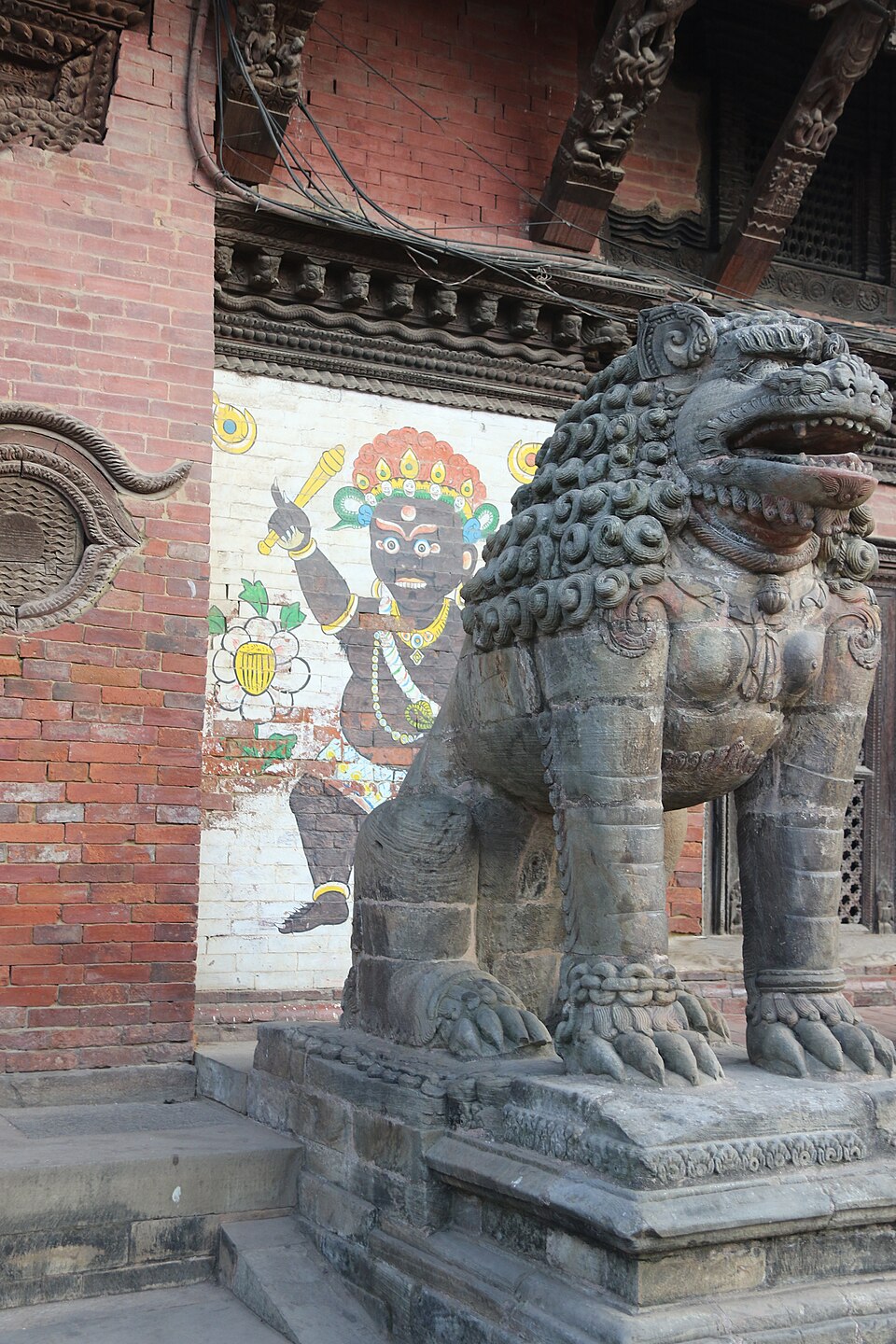
Culturally, the lion holds a place of high honor across various Indian traditions. From the Ashoka Lions that crown the state emblem of India to the intricate carvings in ancient temples, the lion serves as a sentinel of sacred spaces. It reminds the practitioner that while the path to spirituality requires gentleness and compassion, it also necessitates a lion-like courage to confront the shadows within oneself and the injustices of the world. This dual nature—the protector and the destroyer of evil—makes the lion an indispensable symbol in the Vedic and Puranic traditions.
Significance
In the context of Goddess Durga, the lion is a symbol of 'Shakti' (power) in its most active and dynamic form. The symbology suggests that to achieve liberation, one must not suppress their natural strength but rather channel it toward higher purposes. The lion's ferocity is directed away from mindless violence and toward the destruction of the 'Asuric' (demonic) qualities within the human psyche—such as lust, wrath, and delusion. Thus, the lion is an ally in the internal battle for self-realization.
Astrologically, the lion is associated with the zodiac sign Leo (Simha Rashi), ruled by the Sun (Surya). This connection reinforces themes of leadership, vitality, sovereignty, and the solar energy that sustains life. In many Vedic rituals, the qualities of the lion—unwavering focus and fearless determination—are invoked to help the practitioner overcome obstacles (Vighna) and achieve success in both material and spiritual endeavors.
Furthermore, the lion serves as a bridge between the human and the divine. In the worship of Narasimha, the lion-form teaches that the Divine is not always found in peaceful stillness, but often in the intense, dynamic movement of justice. This provides a profound theological lesson: God is both the calm ocean and the raging storm. For the devotee, contemplating the lion invites a sense of 'Veera Rasa' (the heroic sentiment), encouraging a life lived with dignity, purpose, and an unshakeable commitment to truth.
Best Time to Recite
Find your exact auspicious time Check the shubh muhurat and choghadiya for your city and date.
How to Recite
- 1Begin with Pranayama (breath control) to calm the mind and channel focus.
- 2Invoke Lord Ganesha to remove obstacles from your spiritual practice.
- 3Visualize the lion as a guardian of your sacred space, filtering out negative energies.
- 4If worshipping Durga, meditate on her riding the lion, visualizing the lion's strength merging with her wisdom.
- 5If worshipping Narasimha, meditate on his protective gaze, feeling the dissolution of fear.
- 6Chant the prescribed mantras with focused intention (Dhyana).
- 7Offer flowers and incense as a gesture of surrender (Sharanagati).
- 8Conclude with a prayer for the strength to uphold Dharma in daily life.
Mantras
Durga Mantra (to invoke the power of the Lion-Rider)
ॐ दुं दुर्गायै नमः
Om Dum Durgayai Namaha
Meaning: Salutations to the Goddess Durga, the invincible protector.
Narasimha Maha-Mantra
उग्रं वीरं महाविष्णुं ज्वलन्तं सर्वतोमुखम्। नृसिंहं भीषणं भद्रं मृत्युमृत्युं नमाम्यहम्॥
Ugram Veeram Maha-Vishnum Jvalantam Sarvato-Mukham | Nrsimham Bhishanam Bhadram Mrityu-Mrityum Namamyaham ||
Meaning: I bow to the ferocious and heroic Maha-Vishnu, who burns with light and faces all directions; to the terrifying yet auspicious Narasimha, who is the death of death itself.
Do's
- ✓Focus on the 'Veera' (heroic) quality of the deity.
- ✓Offer red flowers, which are associated with both Durga and the lion's energy.
- ✓Maintain a steady and unwavering gaze during meditation (Trataka).
Don'ts
- ✗Do not approach these powerful forms with a mind full of chaotic or violent intent.
- ✗Avoid discussing or thinking of trivialities during the mantra chanting.
- ✗Do not disrespect any form of animal life, as all carry a spark of the divine.
Common Mistakes to Avoid
- •Misinterpreting the lion's ferocity as mere aggression rather than righteous protection.
- •Focusing only on the physical form of the lion rather than its spiritual symbolism.
- •Performing rituals mechanically without internalizing the meaning of the mantras.
Frequently Asked Questions
Why does Goddess Durga ride a lion instead of a more docile animal?▾
What is the difference between the lion as a Vahana and Narasimha?▾
Can I meditate on the lion symbolism if I am not a practitioner of Hinduism?▾
Popular Tools
References & Traditional Notes
- •The Devi Mahatmya is the primary scriptural source for Durga's iconography.
- •The Bhagavata Purana provides the detailed narrative of the Narasimha Avatara.
- •Customs regarding the specific style of lion depiction may vary between Shakta and Vaishnava lineages.
Related Audio & Bhajans
Shop Pooja & Festive Essentials on Flipkart
Clicking opens Flipkart via our affiliate link. Prices and availability may vary.
Shop on FlipkartCueLinks Publisher: 300371
Shop Festive Wear on Myntra
Clicking opens Myntra via our affiliate link. Prices and availability may vary.
CueLinks Publisher: 300371
Need a website? Describe it, and AI builds it.
Perfect for a temple, pooja service, astrology practice or small shop. Tell the AI what you want — or drag and drop the classic way — and go live on your own web address in minutes with Sitova. Hosting, SEO, forms and analytics are all included.
- Build with AI or drag & drop
- Your domain + SEO built in
- Free forever plan
Opens sitova.site