
Trimurti — Brahma, Vishnu, Mahesh and the Cosmic Cycle
Explore the Hindu Trimurti — Brahma the creator, Vishnu the preserver, Shiva the destroyer — and their role in the eternal cosmic cycle of creation, preservation, and dissolution.
Affiliate disclosure: Sanatan Hindu participates in the Amazon Associates Programme and the CueLinks affiliate network (Myntra & Flipkart). This page contains affiliate links, if you click and buy, we earn a small commission at no extra cost to you. As an Amazon Associate we earn from qualifying purchases. Full disclosure.
Next Kartik Purnima
Tuesday, 24 November 2026· in 37 days
Set a reminder so you never miss Kartik Purnima.
Introduction
Significance
Auspicious Time
Find your exact auspicious time Check the shubh muhurat and choghadiya for your city and date.
Required Samagri (Materials)
Preparation Steps
- 1Clean the puja altar and surrounding area thoroughly.
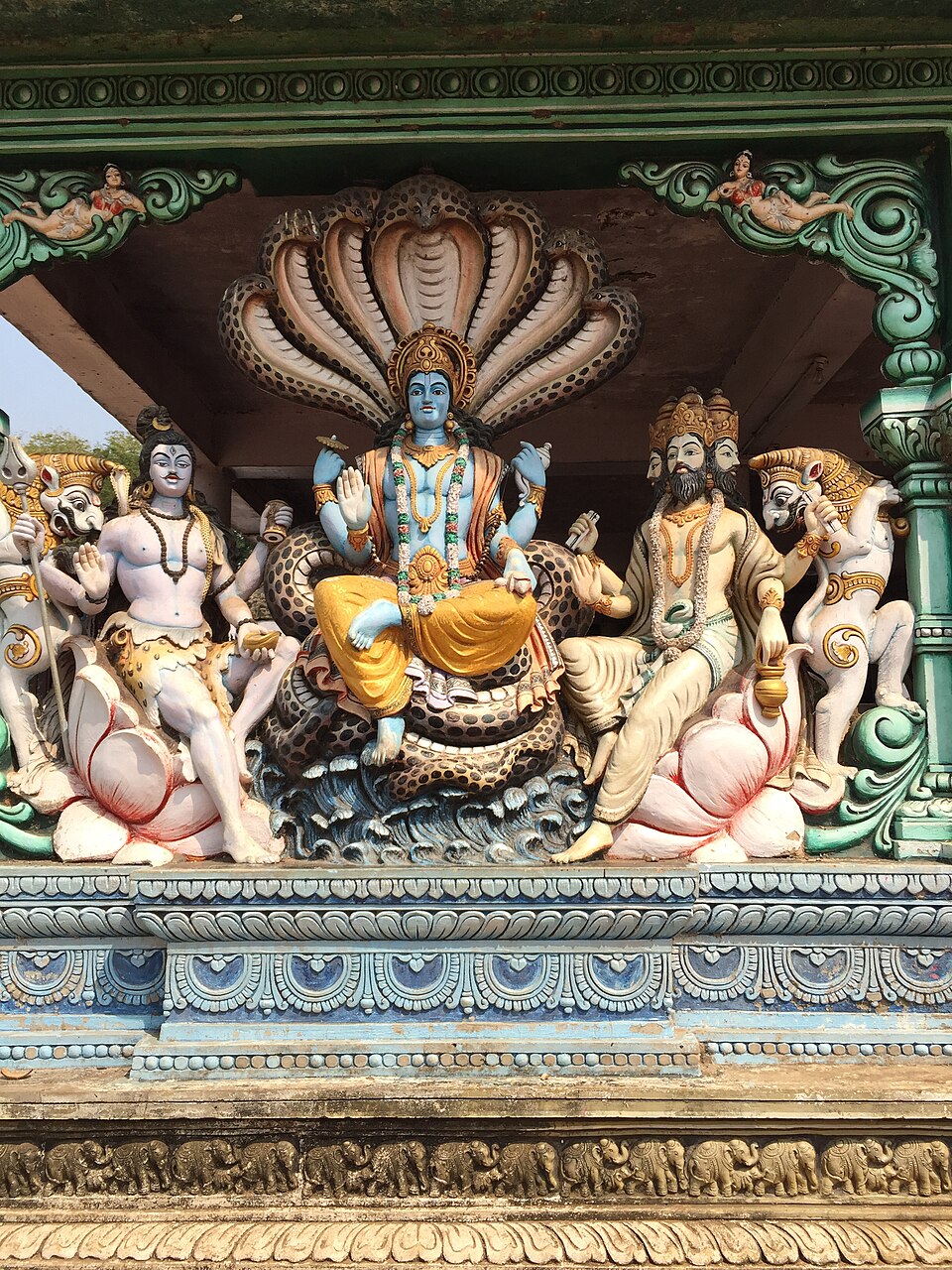
- 2Place murtis or images of Brahma, Vishnu, and Shiva on a clean platform, ideally with Vishnu in the center, Brahma to the right, Shiva to the left.
- 3Prepare panchamrita and keep it in a silver or copper vessel.
- 4Light the ghee lamp and incense.
- 5Invoke Lord Ganesha first to remove obstacles (Om Gan Ganapataye Namah).
- 6Arrange offerings: flowers, fruits, water, chandan, akshata, tulsi, bilva leaves.
- 7Sit facing east or north in a comfortable posture.
Steps
- 1Begin with achamana (sipping water thrice while chanting Om Kesavaya Namah, Om Narayanaya Namah, Om Madhavaya Namah).
- 2Perform pranayama and sankalpa (statement of intent) for Trimurti puja.
- 3Invoke each deity with their respective dhyana shlokas and offer panchopachara (five offerings: gandha, pushpa, dhoopa, deepa, naivedya) or shodashopachara (sixteen offerings) as per capacity.
- 4Offer white flowers and chandan to Brahma while chanting Brahma mantras.
- 5Offer yellow flowers, tulsi, and chandan to Vishnu while chanting Vishnu mantras.
- 6Offer bilva leaves, white flowers, vibhuti, and chandan to Shiva while chanting Shiva mantras.
- 7Perform arati with camphor or ghee lamp, moving clockwise.
- 8Offer naivedya and distribute prasada.
- 9Conclude with pradakshina (circumambulation) and namaskara.
- 10Meditate on the unity of the Trimurti as the one Brahman.
Mantras
Brahma Gayatri Mantra
ॐ ब्रह्मणे विद्महे हिरण्यगर्भाय धीमहि तन्नो ब्रह्मा प्रचोदयात्।
Om Brahmane Vidmahe Hiranyagarbhaya Dhimahi Tanno Brahma Prachodayat
Meaning: We meditate on Brahma, the creator, the golden-wombed one; may Brahma inspire our intellect.
Vishnu Gayatri Mantra
ॐ नारायणाय विद्महे वासुदेवाय धीमहि तन्नो विष्णुः प्रचोदयात्।
Om Narayanaya Vidmahe Vasudevaya Dhimahi Tanno Vishnuh Prachodayat
Meaning: We meditate on Narayana, the indweller of all; may Vishnu inspire our intellect.
Shiva Panchakshari Mantra
ॐ नमः शिवाय।
Om Namah Shivaya
Meaning: Salutations to Shiva, the auspicious one, the transformer.
Trimurti Unity Mantra
ॐ त्रिमूर्तये नमः।
Om Trimurtaye Namah
Meaning: Salutations to the three-formed one (the Trimurti as a unity).
Brahma-Vishnu-Shiva Dhyana Shloka
ब्रह्मा विष्णुः शिवश्चैव त्रिमूर्तिः परमेश्वरः। एको देवः त्रिधा भूतः सृष्टिस्थितिसंहारकृत्॥
Brahma Vishnuh Shivashchaiva Trimurtih Parameshvarah Eko Devah Tridha Bhutah Srishti-Sthiti-Samhara-Krit
Meaning: Brahma, Vishnu, and Shiva are the Trimurti, the Supreme Lord. The one God becomes threefold, performing creation, preservation, and dissolution.
Guidelines
- •Observe purity of body and mind (shaucha) before puja.
- •Chant at least one mala (108 repetitions) of each deity's mantra daily.
- •Study a portion of the Puranas related to the Trimurti (e.g., Vishnu Purana, Shiva Purana).
- •Practice ahimsa (non-violence) in thought, word, and deed.
- •Fast on Ekadashi for Vishnu, Pradosha for Shiva, and Kartik Purnima for Brahma if observing specific vratas.
Do's
- ✓Worship all three aspects with equal reverence, recognizing their essential unity.
- ✓Understand the philosophical symbolism behind each deity's iconography.
- ✓Visit temples dedicated to each deity (e.g., Pushkar for Brahma, Tirupati for Vishnu, Kashi for Shiva).
- ✓Integrate the lessons of creation (innovation), preservation (duty), and dissolution (letting go) in daily life.
- ✓Teach children the Trimurti concept as a foundation for Hindu theology.
Don'ts
- ✗Do not treat the three as competing or separate gods; they are functional aspects of one Brahman.
- ✗Do not neglect Brahma worship due to the myth of his curse; his role is vital for understanding creation.
- ✗Do not confuse the Trimurti with the Tridevi (Saraswati, Lakshmi, Parvati), though they are consorts/shaktis.
- ✗Do not perform puja without basic purity (bathing, clean clothes).
- ✗Do not argue sectarian superiority (Vaishnavism vs Shaivism) in the context of Trimurti unity.
Common Mistakes to Avoid
- •Believing Brahma, Vishnu, and Shiva are three different supreme gods rather than three roles of one Supreme.
- •Thinking Shiva's destruction is negative; it is transformative and regenerative.
- •Assuming Brahma is unimportant because he has few temples; his cosmic function is indispensable.
- •Ignoring the gunas (rajas, sattva, tamas) as the inner correlates of the Trimurti.
- •Performing rituals mechanically without meditating on the unity of the three.
Regional Variations
- •In South India, the Trimurti is often worshipped together in temples like Thiruvananthapuram (Padmanabhaswamy) where Vishnu reclines on Ananta with Brahma on lotus and Shiva as linga nearby.
- •In Rajasthan, the Brahma Temple at Pushkar is the most famous site for Brahma worship, especially during Kartik Purnima.
- •In Maharashtra, the Trimurti is represented in the form of Dattatreya (combined avatar of Brahma, Vishnu, Shiva) at Mahur and Gangapur.
- •In Shakta traditions, the Trimurti is seen as the three forms of the Goddess: Maha Saraswati (creation), Maha Lakshmi (preservation), Maha Kali (dissolution).
- •In Nepal, the Pashupatinath temple complex includes shrines to all three, and the Muktinath temple venerates Vishnu with Brahma and Shiva.
Frequently Asked Questions
Why are there so few temples dedicated to Brahma compared to Vishnu and Shiva?▾
Is the Trimurti mentioned in the Vedas?▾
How does the Trimurti relate to the concept of Brahman?▾
Can one worship only one deity of the Trimurti and still attain liberation?▾
What is the significance of the Trimurti in daily spiritual practice?▾
Popular Tools
References & Traditional Notes
- •Vishnu Purana (Book 1, Chapter 2) describes the emergence of Brahma from Vishnu's navel and the role of Shiva in dissolution.
- •Shiva Purana (Vidyeshvara Samhita) explains the unity of Brahma, Vishnu, and Shiva as three aspects of Maheshvara.
- •Bhagavata Purana (Canto 2, Chapter 5) narrates the creation by Brahma under Vishnu's direction.
- •Kurma Purana (1.6) states: 'Brahma, Vishnu, and Shiva are the three forms of the one Supreme Lord.'
- •Skanda Purana (Kashi Khanda) glorifies Kashi as the city where all three reside in unity.
- •Dattatreya Upanishad identifies Dattatreya as the combined incarnation of the Trimurti.
- •Adi Shankaracharya's 'Shiva Manasa Puja' and 'Vishnu Sahasranama Bhashya' reflect the non-dual view of the Trimurti.
Related Audio & Bhajans
Affiliate disclosure: Sanatan Hindu participates in the Amazon Associates Programme and the CueLinks affiliate network (Myntra & Flipkart). This page contains affiliate links, if you click and buy, we earn a small commission at no extra cost to you. As an Amazon Associate we earn from qualifying purchases. Full disclosure.
Shop Samagri on Amazon.in
Clicking opens Amazon.in. Prices and availability may vary.
Browse all pooja itemsAmazon Associates tag: geekydevelope-21
Shop Pooja & Festive Essentials on Flipkart
Clicking opens Flipkart via our affiliate link. Prices and availability may vary.
Shop on FlipkartCueLinks Publisher: 300371
Shop Festive Wear on Myntra
Clicking opens Myntra via our affiliate link. Prices and availability may vary.
CueLinks Publisher: 300371
Need a website? Describe it, and AI builds it.
Perfect for a temple, pooja service, astrology practice or small shop. Tell the AI what you want — or drag and drop the classic way — and go live on your own web address in minutes with Sitova. Hosting, SEO, forms and analytics are all included.
- Build with AI or drag & drop
- Your domain + SEO built in
- Free forever plan
Opens sitova.site