
Varaha Avatar — The Boar That Rescued Mother Earth: Complete Guide to Legend, Significance & Worship
Explore the complete legend, spiritual significance, rituals, mantras, and worship practices of Varaha Avatar — Lord Vishnu's boar incarnation who rescued Bhudevi from the cosmic ocean.
Affiliate disclosure: Sanatan Hindu participates in the Amazon Associates Programme and the CueLinks affiliate network (Myntra & Flipkart). This page contains affiliate links, if you click and buy, we earn a small commission at no extra cost to you. As an Amazon Associate we earn from qualifying purchases. Full disclosure.
Introduction
Significance
Best Time to Perform
Find your exact auspicious time Check the shubh muhurat and choghadiya for your city and date.
Required Samagri (Materials)
Preparation Steps
- 1Clean the puja area thoroughly; sprinkle Ganga jal or water mixed with turmeric.
- 2Set up a clean altar facing east or north; place a red or yellow cloth.
- 3Install the Varaha murti or picture on a raised platform; place Bhudevi image beside or on the tusk if depicted.
- 4Prepare panchamrita fresh; keep naivedya covered until offering.
- 5Arrange all samagri in order of use: water, cloth, sandalwood, flowers, incense, lamp, naivedya.
- 6Take a bath and wear clean, preferably traditional clothes (dhoti/kurtas for men, saree/salwar for women).
- 7Light the ghee lamp and incense before beginning; blow conch three times to purify atmosphere.
- 8Invoke Ganesha first with a short prayer to remove obstacles.
- 9Mentally offer the puja to Varaha with sankalpa (intention) stating your name, gotra, purpose, and date/tithi.
Step-by-Step Vidhi
- 1Begin with Achamana: sip water three times from right palm while chanting 'Om Achyutaya Namaha, Om Anantaya Namaha, Om Govindaya Namaha' to purify body and mind.
- 2Perform Pranayama: three rounds of alternate nostril breathing while meditating on Varaha's form — vast, radiant, earth-upholding.
- 3Sankalpa: Formally declare intention — 'Aham [name], [gotra], [location], [tithi/date], Varaha Jayanti/puja karishye' — offering all actions to Vishnu.
- 4Kalasha Sthapana: Invoke Varuna and all sacred rivers into the kalasha; place coconut on top with mango leaves; worship with sandalwood, flowers, akshata.
- 5Ganesha Puja: Offer durva grass, modak, and red flowers to Ganesha; chant 'Om Gam Ganapataye Namaha' 11 times.
- 6Varaha Avahana: Invite Varaha into the murti/picture with 'Om Varahaya Namaha, Avahyami, Sthapayami, Pujaayami' — visualize the cosmic boar descending.
- 7Panchopachara / Shodashopachara Puja: Offer sequentially — Padya (water for feet), Arghya (water for hands), Achamana (water for mouth), Snana (bath with panchamrita then water), Vastra (cloth), Yajnopavita (sacred thread), Gandha (sandalwood), Pushpa (flowers chanting each name), Dhoopa (incense), Deepa (lamp waving), Naivedya (food), Tambula (betel), Dakshina, Namaskara.
- 8Chant Varaha Mantras (see mantras section) — minimum 108 times on rudraksha or tulsi mala.
- 9Read or listen to Varaha Katha from Bhagavata Purana (Canto 3) or Varaha Purana — even a few verses if time is short.
- 10Perform Aarti with camphor/ghee lamp; sing Varaha Aarti or Vishnu Aarti; blow conch at conclusion.
- 11Pradakshina: Circumambulate altar 3 or 7 times clockwise; offer final prostrations (shashtanga or panchanga namaskara).
- 12Distribute prasadam to all present; partake with gratitude. Conclude with 'Om Shanti Shanti Shanti'.
Mantras
Varaha Moola Mantra
ॐ वराहाय नमः
Om Varahaya Namaha
Meaning: Salutations to Lord Varaha, the boar incarnation of Vishnu who uplifts the Earth.
Varaha Gayatri Mantra
ॐ वराहाय विद्महे महावक्राय धीमहि तन्नो वरः प्रचोदयात्
Om Varahaya Vidmahe Mahavakraya Dhimahi Tanno Varaha Prachodayat
Meaning: We meditate on Lord Varaha, the great boar with the curved tusk; may He inspire and illuminate our intellect.
Varaha Dhyanam (Meditation Verse)
नीलमेघश्यामलं गजेन्द्रवदनं चतुर्भुजं शूलचक्रगदापद्मं वराहं प्रणमाम्यहम्
Nilameghashyamalam Gajendravadanam Chaturbhujam Shulachakragadapadmam Varaham Pranamamyaham
Meaning: I bow to Varaha, dark as a rain-cloud, with the face of a great elephant (boar), four-armed, holding trident, discus, mace, and lotus.
Varaha Kavacham (Opening Verse)
ॐ वराह कवचं पठेद् यस्तु भक्त्या समाहितः | सर्वपापविमुक्तो भवेत् विष्णुलोकं गच्छति ||
Om Varaha Kavacham Pathed Yastu Bhaktya Samahitah | Sarvapapavimukto Bhavet Vishnulokam Gachchhati ||
Meaning: One who recites the Varaha Kavacham with devotion becomes free from all sins and attains Vishnu's abode.
Bhudevi Stuti (Earth Goddess Prayer)
ॐ भूर्भुवः स्वः | पृथिवी त्वया धृता लोका देवि त्वं विष्णुना धृता | त्वं च धारय मां देवि पवित्रं कुरु चासनम् ||
Om Bhurbhuvah Svah | Prithivi Tvaya Dhrta Loka Devi Tvam Vishnuna Dhrta | Tvam Cha Dharaya Mam Devi Pavitram Kuru Chasanam ||
Meaning: Om, Earth, Atmosphere, Heaven. O Goddess Earth, you uphold the worlds; you are upheld by Vishnu. O Devi, uphold me and purify my seat.
Varaha Aarti (Complete Traditional Verse)
जय वराह देवा, जय वराह देवा | भूदेवी उद्धारक, प्रभु त्रिलोकी देवा || हिरण्याक्ष दैत्य, मर्दन कियो | वेद पुराण गायें, गुण गाथा तेरो || चतुर्भुज रूप, शंख चक्र गदा | पद्म कर शोभित, वरद हस्त भला || शेष शय्या विराजे, लक्ष्मी संग प्यारे | भक्तन के संकट, दूर करे हमारे || वराह जयन्ती, व्रत जो कोई नर नारी | मनवांछित फल पावे, दुःख बिपत्ति हारी || जय वराह देवा, जय वराह देवा | भूदेवी उद्धारक, प्रभु त्रिलोकी देवा ||
Jai Varaha Deva, Jai Varaha Deva | Bhudevi Uddharak, Prabhu Triloki Deva || Hiranyaksha Daitya, Mardan Kiyo | Veda Purana Gayen, Guna Gatha Tero || Chaturbhuja Roop, Shankha Chakra Gada | Padma Kar Shobhita, Varad Hasta Bhala || Shesha Shayya Viraje, Lakshmi Sang Pyare | Bhaktan Ke Sankat, Door Kare Hamare || Varaha Jayanti, Vrat Jo Koi Nar Nari | Manvanchhit Phal Pave, Dukh Bipatti Hari || Jai Varaha Deva, Jai Varaha Deva | Bhudevi Uddharak, Prabhu Triloki Deva ||
Meaning: Victory to Lord Varaha, victory to Lord Varaha! Uplifter of Mother Earth, Lord of the three worlds. You crushed the demon Hiranyaksha; the Vedas and Puranas sing Your glories. Four-armed, holding conch, discus, mace, and lotus; Your lotus hand bestows boons. Reclining on Shesha with beloved Lakshmi, You remove the distress of devotees. Whoever observes the Varaha Jayanti vow, man or woman, attains their heart's desire and is freed from suffering. Victory to Lord Varaha!
Do's
- ✓Maintain purity of body, speech, and mind throughout the worship.
- ✓Use tulsi leaves in every offering — they are most dear to Vishnu.
- ✓Face east or north while performing puja and japa.
- ✓Chant mantras with correct pronunciation; learn from a guru if possible.
- ✓Offer naivedya with love; prepare it yourself in a clean, sattvic state.
- ✓Include Bhudevi in worship — offer green items (leaves, durva) representing Earth.
- ✓Perform charity (daana) of food, water, or land-related help on this day.
- ✓Plant a tree or support ecological causes as living worship of Varaha.
Don'ts
- ✗Do not cut trees, harm animals, or pollute water bodies on Varaha Jayanti — it contradicts the avatar's essence.
- ✗Avoid anger, lies, gossip, and negative speech during the vrat.
- ✗Do not use plastic, styrofoam, or non-biodegradable items in puja.
- ✗Never place the murti/picture on the floor directly; always use a clean asana.
- ✗Do not offer stale, tamasic, or non-vegetarian food as naivedya.
- ✗Avoid wearing black or torn clothes during worship.
- ✗Do not rush through the puja; each step is an offering of attention.
- ✗Never disrespect the boar form — it is the Divine Himself; avoid cultural prejudices.
Common Mistakes to Avoid
- •Confusing Varaha with other boar deities (e.g., Emusha in Vedic ritual, or local folk boar gods) — Varaha is specifically Vishnu's avatar.
- •Skipping Bhudevi worship — She is inseparable from Varaha; omitting Her reduces the puja's completeness.
- •Using only generic Vishnu mantras instead of Varaha-specific ones — each avatar has unique vibrational keys.
- •Performing puja without sankalpa — intention directs the energy; mechanical ritual lacks potency.
- •Neglecting the ecological dimension — Varaha worship without Earth-care is incomplete per the Varaha Purana's spirit.
- •Observing the vrat only externally (food rules) without internal sadhana (japa, meditation, charity).
- •Using chemical-laden or artificial items in puja — they carry tamasic vibrations.
- •Not consulting family tradition — some lineages have specific Varaha mantras, kavas, or procedures.
Regional Variations
- •Tirumala (Andhra Pradesh): Varaha Swamy temple adjacent to Venkateswara; first darshan is Varaha before Balaji — He is kshetra-palaka. Special abhishekam with 108 kalashas on Varaha Jayanti.
- •Srimushnam (Tamil Nadu): Self-manifested (swayambhu) Varaha murti; worshipped as Bhu Varaha with consort Ambujavalli Thayar. Unique ritual: earth from anthill offered as prasadam.
- •Ahobilam (Andhra Pradesh): Varaha Narasimha combined form; the boar-lion syncretism reflects the Narasimha-Varaha continuum in Pancharatra theology.
- •Kerala: Varaha worship integrated into temple rituals for land fertility; Varaha homam performed before construction. Boar form less emphasized; focus on Vishnu as Earth-upholder.
- •Bengal/Odisha: Varaha depicted in temple sculpture (Konark, Puri) but less standalone worship; focus on Jagannath (Vishnu) as cosmic sustainer. Varaha Jayanti observed in Vaishnava mathas.
- •North India (Mathura/Vrindavan, Kashi): Varaha Ghat and temples; worship on Kartik Purnima also. Emphasis on Bhagavata Purana recitation. Varaha linked to Govardhan lila (lifting mountain).
- •Maharashtra: Varaha associated with Vithoba (Pandharpur) as 'Bhudhar' (Earth-bearer); Varaha Jayanti marked by abhanga singing and feeding cows.
- •Nepal: Varaha (Baraha) worship at Barahakshetra (Koshi River); major pilgrimage for shraddha rites. Boar form prominent; tantric elements in ritual.
Frequently Asked Questions
Why did Vishnu take the form of a boar specifically?▾
Is Varaha worship only for those with property or land issues?▾
Can women perform Varaha puja and observe the vrat?▾
What is the difference between Varaha and Narasimha avatars?▾
How is Varaha related to environmentalism in Hinduism?▾
Can I worship Varaha at home without a temple murti?▾
Popular Tools
References & Traditional Notes
- •Primary scriptural sources: Bhagavata Purana (3.13–19), Vishnu Purana (1.4–5), Varaha Purana (entire text), Padma Purana (Srishti Khanda), Agni Purana (Ch. 4–5), Skanda Purana (Vaishnava Khanda).
- •Pancharatra texts: Ahirbudhnya Samhita, Jayakhya Samhita — detail Varaha's iconography and mantra sadhana.
- •Temple traditions: Tirumala Tirupati Devasthanams (Varaha Swamy), Srimushnam Bhu Varaha Temple, Ahobilam, Barahakshetra (Nepal), Varaha Temple (Khajuraho), Varaha Ghat (Mathura).
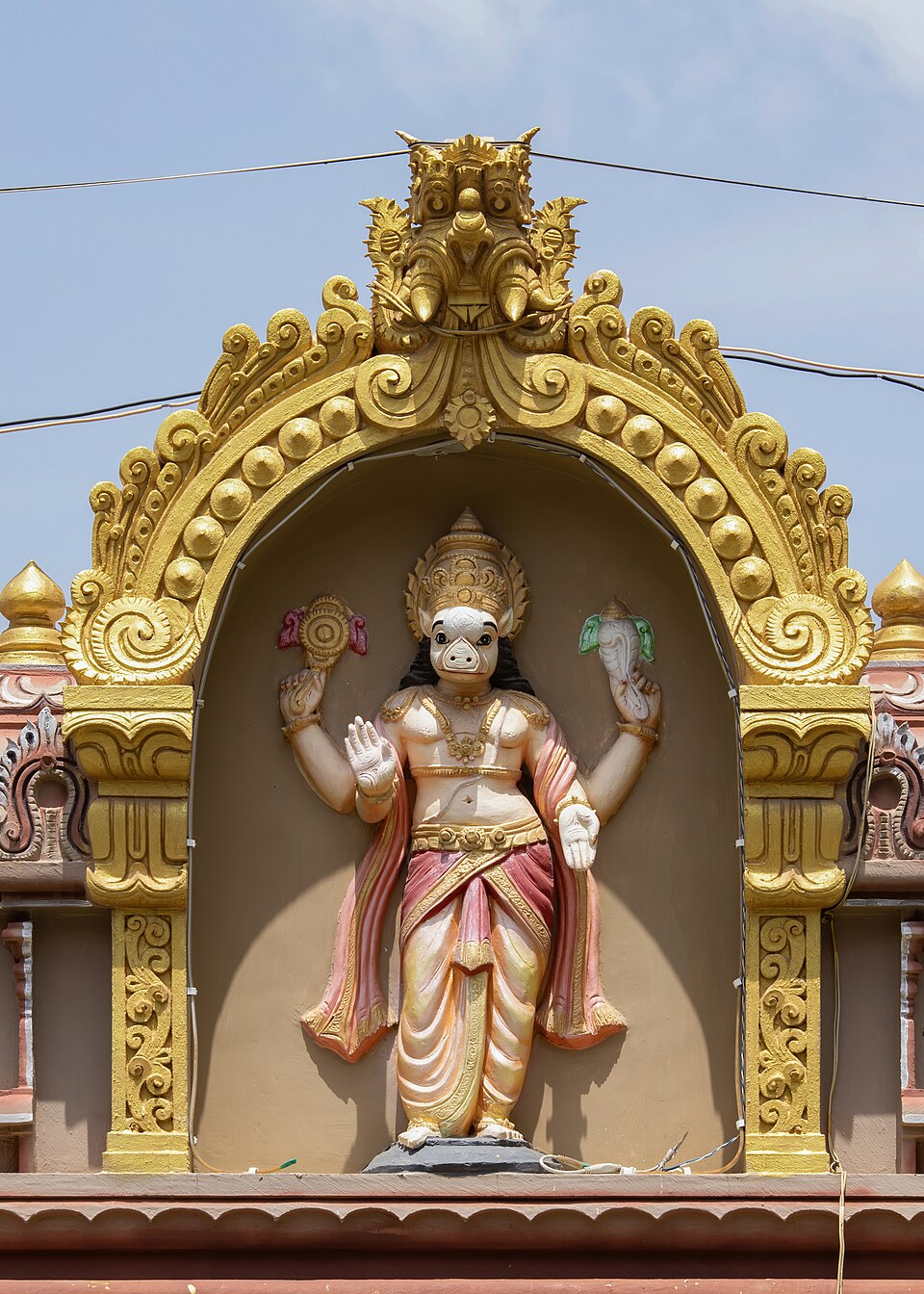
- •Iconography per Shilpa Shastras: Varaha depicted as boar-headed, human-bodied (or fully boar), 4-armed (shankha, chakra, gada, padma or varada/abhaya), standing on serpent Shesha or ocean, lifting Bhudevi on right tusk. Bhudevi shown as goddess with folded hands or hanging gracefully.
- •Varaha Jayanti date: Bhadrapada Shukla Dwitiya (2nd day of waxing moon in Bhadrapada, Aug–Sep). Some traditions also observe on Magha Shukla Dwitiya or Kartik Purnima.
- •The Varaha Kavacham (armor hymn) and Varaha Stotram by Vedanta Desika are key devotional texts for daily recitation.
- •In Vaikhanasa and Pancharatra Agama traditions, Varaha is one of the five primary forms (Para, Vyuha, Vibhava, Antaryamin, Archa) — specifically a Vibhava (incarnation) form for worship.
- •Family traditions vary: Some Smarta families include Varaha in Dashavatara puja on Gudi Padwa; Sri Vaishnavas emphasize Varaha as first Vibhava; Madhvas recite Varaha episodes during Chaturmasya.
Related Audio & Bhajans
Om Jai Jagdish Hare
Varaha Avatar Stotra
Affiliate disclosure: Sanatan Hindu participates in the Amazon Associates Programme and the CueLinks affiliate network (Myntra & Flipkart). This page contains affiliate links, if you click and buy, we earn a small commission at no extra cost to you. As an Amazon Associate we earn from qualifying purchases. Full disclosure.
Shop Samagri on Amazon.in
Clicking opens Amazon.in. Prices and availability may vary.
Browse all pooja itemsAmazon Associates tag: geekydevelope-21
Shop Pooja & Festive Essentials on Flipkart
Clicking opens Flipkart via our affiliate link. Prices and availability may vary.
Shop on FlipkartCueLinks Publisher: 300371
Shop Festive Wear on Myntra
Clicking opens Myntra via our affiliate link. Prices and availability may vary.
CueLinks Publisher: 300371
Need a website? Describe it, and AI builds it.
Perfect for a temple, pooja service, astrology practice or small shop. Tell the AI what you want — or drag and drop the classic way — and go live on your own web address in minutes with Sitova. Hosting, SEO, forms and analytics are all included.
- Build with AI or drag & drop
- Your domain + SEO built in
- Free forever plan
Opens sitova.site