
Yoga Nidra — Yogic Sleep Meditation Technique and Benefits
Discover Yoga Nidra, the ancient yogic sleep meditation for deep relaxation, healing, and spiritual awakening. Learn technique, benefits, mantras, and practice guidelines.
Affiliate disclosure: Sanatan Hindu participates in the Amazon Associates Programme and the CueLinks affiliate network (Myntra & Flipkart). This page contains affiliate links, if you click and buy, we earn a small commission at no extra cost to you. As an Amazon Associate we earn from qualifying purchases. Full disclosure.
Introduction
Significance
Auspicious Time
Find your exact auspicious time Check the shubh muhurat and choghadiya for your city and date.
Required Samagri (Materials)
Preparation Steps
- 1Choose a consistent time and place for practice to build a conditioned relaxation response.
- 2Ensure the room is well-ventilated, dimly lit, and at a comfortable temperature (around 22–24°C / 72–75°F).
- 3Turn off phones and electronic devices; inform household members not to disturb.
- 4Empty bladder and bowels if needed; avoid heavy meals, caffeine, or stimulants for 2–3 hours prior.
- 5Wear loose, non-restrictive clothing; remove jewelry, watches, glasses.
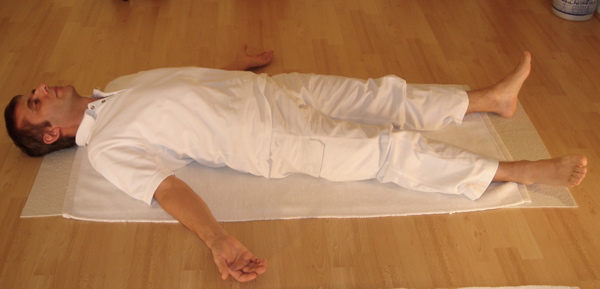
- 6Lie down in Shavasana (Corpse Pose): supine, legs slightly apart (1–2 feet), arms 15–30 cm from body, palms facing up, fingers naturally curled.
- 7Adjust head support so neck is neutral — chin slightly tucked toward chest, not tilted back.
- 8Cover body with a light blanket to prevent chill during prolonged stillness.
- 9Place eye cover gently over closed eyes to block light and signal sensory withdrawal.
- 10Take 3–5 deep diaphragmatic breaths, exhaling with a soft 'ha' sound to release tension.
- 11Set a clear, positive Sankalpa (resolve) in the present tense (e.g., 'I am calm and centered,' 'My body heals itself'). Repeat mentally three times with conviction.
- 12Commit to remaining still and awake throughout the practice — if sleep comes, acknowledge it without judgment and return to the guide's voice.
Steps
- 11. Externalization (Bahiranga): Begin by bringing awareness to the external environment — sounds, smells, temperature, contact points of body with floor. Do not analyze; simply witness. Gradually withdraw attention from outer senses (pratyahara).
- 22. Internalization (Antaranga) & Body Rotation (Anga Nyasa): Systematically rotate consciousness through body parts in a specific sequence (right side first, then left, then whole body). Typical order: right thumb, second finger, third, fourth, fifth, palm, wrist, forearm, elbow, upper arm, shoulder, armpit, waist, hip, thigh, knee, calf, ankle, heel, sole, toes — then repeat left side. Then: crown, forehead, eyebrows, eyes, ears, nose, lips, teeth, tongue, jaw, throat, chest, abdomen, navel, lower back, buttocks, whole spine, whole head, whole torso, whole right leg, whole left leg, whole right arm, whole left arm, entire body. Mentally repeat each part's name as you touch it with awareness. This induces sensory-motor cortex relaxation and cortical mapping.
- 33. Breath Awareness (Prana Dharana): Shift focus to natural breath. Observe the breath at the nostrils (cool inhalation, warm exhalation), or the rise/fall of abdomen, or the movement of breath in the throat (ujjayi). Count breaths backward from 27 to 1 (or 54 to 1) — 'I am breathing in 27, breathing out 27...' If mind wanders, restart. This anchors attention and calms the nervous system.
- 44. Opposite Sensations (Dvandva Anubhava): Experience pairs of opposites without judgment: heaviness/lightness, heat/cold, pain/pleasure, anxiety/calm. This develops equanimity (samata) and dissolves reactive patterns.
- 55. Visualization (Chidakasha Dharana): In the dark space behind closed eyes (chidakasha), visualize guided images: a candle flame, lotus, OM symbol, chakra symbols, deities, nature scenes, or abstract light. Alternatively, practice *rapid image visualization* — quickly shifting neutral images to clear subconscious debris. This activates the right brain and accesses the symbolic language of the unconscious.
- 66. Sankalpa (Resolve) Reinforcement: Return to the Sankalpa set at the beginning. Repeat it mentally three times with deep feeling and faith (shraddha). The subconscious is now highly receptive; the resolve acts as a seed for transformation.
- 77. Externalization & Return: Slowly bring awareness back to the body, breath, surroundings. Wiggle fingers and toes. Take a deep breath. Roll onto the right side (fetal position) and pause — this activates the left nostril (ida nadi), promoting calm. Sit up slowly in a comfortable cross-legged posture. Rub palms together, place over eyes, then open eyes gently. Sit quietly for a minute, journal insights.
Mantras
Opening Sankalpa Mantra
ॐ असतो मा सद्गमय । तमसो मा ज्योतिर्गमय । मृत्योर्मा अमृतं गमय ॐ शान्तिः शान्तिः शान्तिः
Om asato ma sadgamaya. Tamaso ma jyotirgamaya. Mrityor ma amritam gamaya. Om shantih shantih shantih
Meaning: Lead me from untruth to truth, from darkness to light, from death to immortality. Om peace, peace, peace. This Upanishadic mantra (Brhadaranyaka Upanishad 1.3.28) sets the spiritual intention for the practice.
Guru Mantra for Guidance
ॐ गुरुर्ब्रह्मा गुरुर्विष्णुः गुरुर्देवो महेश्वरः । गुरुः साक्षात् परब्रह्म तस्मै श्रीगुरवे नमः
Om gurur brahma gurur vishnuh gurur devo maheshvarah. Guruh sakshat parabrahma tasmai shri gurave namah
Meaning: The guru is Brahma, Vishnu, and Shiva; the guru is the supreme Brahman itself. Salutations to that revered guru. Invokes the guru principle for inner guidance during Yoga Nidra.
Closing Peace Mantra
ॐ सर्वे भवन्तु सुखिनः सर्वे सन्तु निरामयाः । सर्वे भद्राणि पश्यन्तु मा कश्चिद्दुःखभाग्भवेत् ॐ शान्तिः शान्तिः शान्तिः
Om sarve bhavantu sukhinah sarve santu niramayah. Sarve bhadrani pashyantu ma kashchid duhkhabhag bhavet. Om shantih shantih shantih
Meaning: May all be happy, may all be free from illness, may all see auspiciousness, may none suffer. Om peace, peace, peace. Universal well-wishing to seal the practice.
Guidelines
- •Maintain a sattvic diet (fresh, vegetarian, moderate) on practice days to support subtle energy.
- •Observe silence (mauna) for at least 30 minutes before and after practice if possible.
- •Practice daily at the same time for a minimum of 40 days (mandala) to establish the samskara.
- •Avoid alcohol, recreational drugs, and excessive sensory stimulation (loud media, arguments) on practice days.
- •Sleep on the right side at night to maintain ida nadi dominance and calm mind.
- •Keep a practice journal to track sankalpa progress, dreams, and inner shifts.
Do's
- ✓Practice consistently — even 20 minutes daily is more effective than 60 minutes weekly.
- ✓Use a trusted teacher's voice or high-quality recording initially; transition to self-guided over time.
- ✓Keep the Sankalpa short, positive, present-tense, and personally meaningful.
- ✓Remain still; if an itch or discomfort arises, observe it without moving — it will pass.
- ✓Accept whatever arises: sleep, emotions, memories, visions — all are part of the purification.
- ✓Practice on an empty or light stomach for deeper relaxation.
- ✓Integrate insights into daily life — Yoga Nidra is not separate from life.
Don'ts
- ✗Do not practice while driving, operating machinery, or in unsafe environments.
- ✗Do not force wakefulness aggressively — if you fall asleep regularly, practice sitting up or at a different time.
- ✗Do not change the Sankalpa frequently; it needs time (months) to take root.
- ✗Do not practice immediately after intense asana or exercise without a transition period.
- ✗Do not analyze or judge experiences during practice — save reflection for after.
- ✗Do not skip the final externalization step; abrupt return can cause disorientation.
- ✗Do not treat it as a substitute for professional mental health care when needed.
Common Mistakes to Avoid
- •Confusing Yoga Nidra with simple relaxation or sleep — the key is *conscious* relaxation.
- •Rushing through body rotation without genuine awareness on each part.
- •Using a Sankalpa that is negative ('I will not smoke') or future-oriented ('I will be happy').
- •Practicing in a noisy, interrupted environment without preparation.
- •Expecting dramatic experiences every session — subtle shifts are more common and sustainable.
- •Skipping the Sankalpa or doing it mechanically without feeling.
- •Practicing only when stressed instead of as a daily preventive sadhana.
Regional Variations
- •In the Bihar School of Yoga (Satyananda) tradition: 8-stage structure with fixed sequence, emphasis on chidakasha visualization and chakra awareness.
- •In the Himalayan Tradition (Swami Rama): Shorter, more meditative format; integrates breath retention (kumbhaka) and mantra japa during rotation.
- •In Kerala's Tantric lineages: Incorporates *nyasa* with bija mantras placed on each body part (e.g., 'Om Lam' at muladhara).
- •In modern therapeutic adaptations (iRest by Richard Miller): Secular language, trauma-sensitive, focuses on 'inner resource' and 'opposite emotions'.
- •In household practice: Simplified 10–15 minute body scan before sleep, often without formal Sankalpa or visualization.
- •In some South Indian guru paramparas: Practiced after evening sandhya vandana, with Gayatri mantra as Sankalpa.
Frequently Asked Questions
Is Yoga Nidra the same as hypnosis?▾
Can I practice Yoga Nidra if I have trauma or PTSD?▾
How long should a Yoga Nidra session be?▾
What if I fall asleep every time?▾
Can children practice Yoga Nidra?▾
Is a teacher necessary, or can I learn from recordings?▾
Popular Tools
References & Traditional Notes
- •Mandukya Upanishad (with Gaudapada Karika) — foundational text on four states of consciousness and Turiya.
- •Yoga Taravali (by Adi Shankaracharya) — verses 24–26 describe Yoga Nidra as a means to Raja Yoga.
- •Hatha Yoga Pradipika (4.37–39) — mentions Yoga Nidra as a practice to conquer sleep and death.
- •Vijnana Bhairava Tantra (verse 56) — 'By the practice of Yoga Nidra, one enters the state of Bhairava.'
- •Swami Satyananda Saraswati, *Yoga Nidra* (Bihar School of Yoga, 1976) — modern classic with full script and theory.
- •Swami Rama, *Yoga and Psychotherapy* (Himalayan Institute) — integrates Yoga Nidra with Western psychology.
- •Richard Miller, *Yoga Nidra: A Meditative Practice for Deep Relaxation and Healing* (iRest protocol).
- •Ayurvedic texts (Charaka Samhita, Ashtanga Hridaya) — reference to *nidra* as one of the three pillars of health (trayopastambha): ahara, nidra, brahmacharya.
Related Audio & Bhajans
Om Jai Shiv Omkara - Shiv Aarti
Om Namah Shivay Dhun
Introduction
Benefits
Shiva Stotras and Mantras
Yoga & Meditation
Affiliate disclosure: Sanatan Hindu participates in the Amazon Associates Programme and the CueLinks affiliate network (Myntra & Flipkart). This page contains affiliate links, if you click and buy, we earn a small commission at no extra cost to you. As an Amazon Associate we earn from qualifying purchases. Full disclosure.
Shop Samagri on Amazon.in
Clicking opens Amazon.in. Prices and availability may vary.
Browse all pooja itemsAmazon Associates tag: geekydevelope-21
Shop Pooja & Festive Essentials on Flipkart
Clicking opens Flipkart via our affiliate link. Prices and availability may vary.
Shop on FlipkartCueLinks Publisher: 300371
Shop Festive Wear on Myntra
Clicking opens Myntra via our affiliate link. Prices and availability may vary.
CueLinks Publisher: 300371