
Garuda: The Divine Eagle and Eternal Enemy of Serpents
Explore the profound legend of Garuda, the celestial king of birds, the mount of Lord Vishnu, and his eternal cosmic struggle against the Nagas.
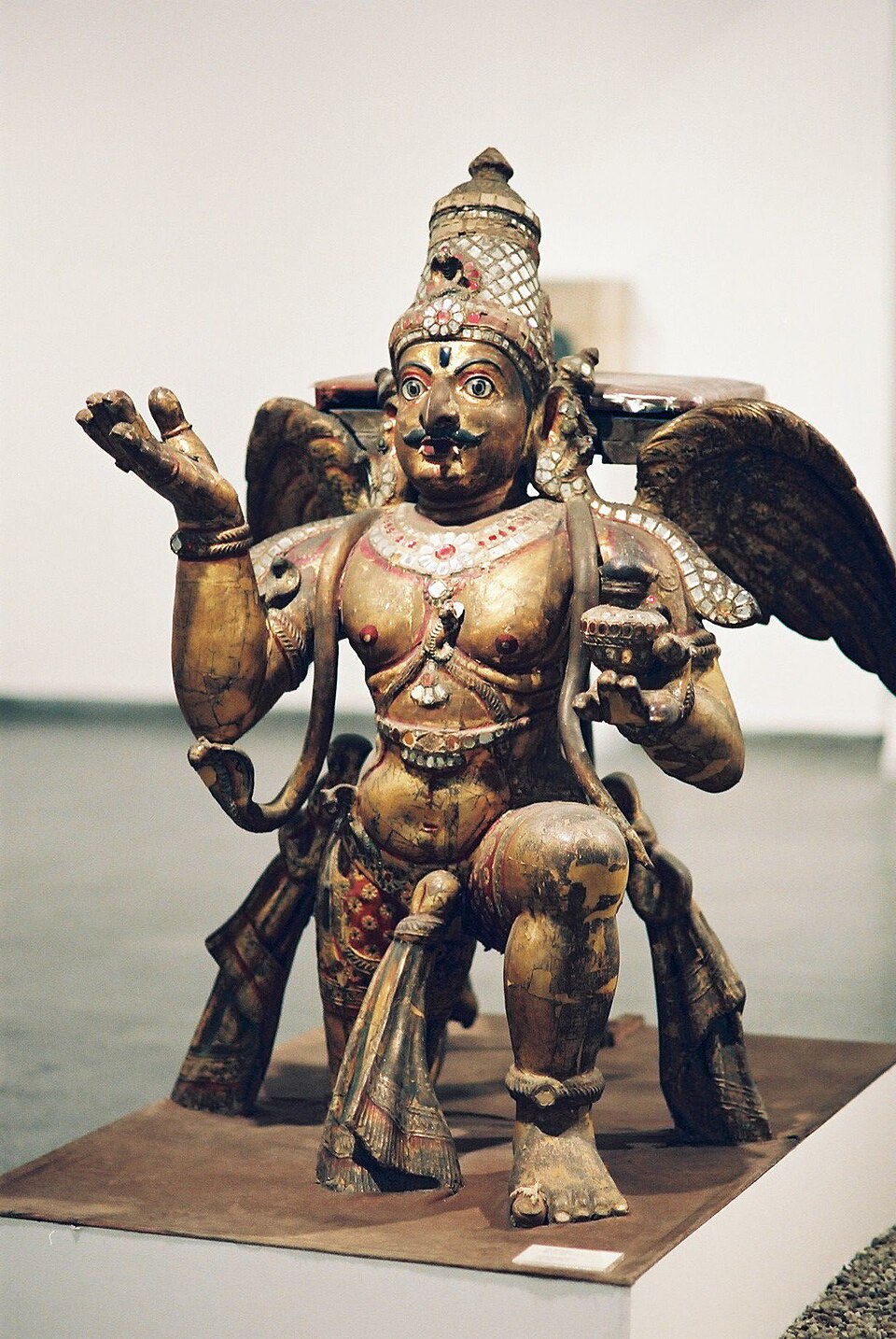
Introduction
The legend of Garuda begins with his birth to the sage Kashyapa and Vinata. His life is defined by a profound struggle for justice and maternal honor. Vinata, his mother, was enslaved by Kadru, the mother of the Nagas (serpents), through a deceptive wager. To liberate his mother from this servitude, Garuda undertook an epic quest to the celestial realms to obtain Amrita (the nectar of immortality). This journey, filled with trials against the gods themselves, showcased his unparalleled valor and strength. Ultimately, through his prowess and his eventual devotion to Vishnu, he secured the nectar, not for himself, but to satisfy the terms of his mother's freedom, thus establishing his character as a hero of supreme integrity.
In the cosmic hierarchy, Garuda occupies a position of immense prestige. He is the 'Suparna' (the beautifully winged one), capable of spanning the heavens with a single flap of his wings. His physical form is often depicted as a hybrid—having the golden body, wings, and beak of an eagle, yet possessing the muscular torso and limbs of a human. This duality symbolizes the union of animal instinct and divine intelligence. He is the protector of the Dharma, often seen descending from the heavens to strike down those who cause chaos or imbalance in the universe.
Beyond his physical might, Garuda represents the soaring human soul seeking liberation (Moksha). Just as an eagle rises above the clouds to see the world clearly, the seeker of truth must rise above the 'serpents' of worldly attachment, ego, and ignorance. The relationship between Garuda and the Nagas is not merely a physical enmity but a deep spiritual allegory: the bird (representing the higher consciousness or the breath/Prana) must constantly transcend the serpent (representing the lower instincts, Kundalini in its unrefined state, or the earthly attachments that bind us).
Significance
Spiritually, the 'Garuda-Naga' conflict is a vital allegory for the internal battle of the seeker. The Nagas, residing in the dark, subterranean depths, represent the unconscious drives, fears, and the cyclical nature of worldly desires. Garuda, soaring in the sunlit heights, represents the awakened intellect (Buddhi) and the soaring spirit. To worship or meditate upon Garuda is to invoke the strength to rise above one's base impulses and to transform 'poisonous' thoughts into spiritual nectar. This is why Garuda is often invoked in rituals meant to remove toxins, both physical and spiritual.
In the realm of astrology and Vedic science, Garuda is closely associated with the movement of planets and the concept of 'Vayu' (air/wind). His immense speed is linked to the swiftness of thought and the element of air, which is essential for the movement of Prana (life force) within the body. In certain traditions, Garuda is invoked to mitigate the ill effects of Rahu and Ketu (the lunar nodes), which are often associated with serpentine energy and sudden upheavals. By aligning oneself with the 'Garuda energy,' a practitioner seeks stability and clarity amidst the turbulence of planetary shifts.
Culturally, Garuda is a symbol of protection. In many Indian households, images of Garuda are placed to ward off evil eye and negative energies. His fierce aspect is believed to repel 'Sarpa Dosha' (the affliction of serpents) and other forms of malefic influence. The Garuda Purana, though often associated with the study of death and the afterlife, also provides profound insights into the soul's journey, emphasizing that the ultimate destination of the righteous is to soar alongside the Divine, much like Garuda himself.
Best Time to Recite
Find your exact auspicious time Check the shubh muhurat and choghadiya for your city and date.
How to Recite
- 1Begin by lighting the Deepam (lamp) and incense to purify the atmosphere.
- 2Perform Achamana (sipping water) to purify oneself internally.
- 3Offer Sandalwood paste to the deity of Garuda or Vishnu.
- 4Offer fresh flowers and fruits with devotion, visualizing Garuda's golden wings spreading protection over you.
- 5Chant the Garuda Mantra with focused concentration, visualizing the deity descending from the sky.
- 6Perform a simple Arati if possible, circling the light in a clockwise direction.
- 7Conclude with a prayer for strength, courage, and the removal of obstacles (Naga-related afflictions).
Mantras
Garuda Moola Mantra
ॐ गरुड़ाय नमः
Om Garudaya Namah
Meaning: Salutations to the Divine Garuda.
Garuda Gayatri Mantra
ॐ सुपर्णाय विद्महे, वज्रनेत्राय धीमहि, तन्नो गरुडः प्रचोदयात्
Om Suparnaya Vidmahe, Vajranetraya Dhimahi, Tanno Garudah Prachodayat
Meaning: Om, let us meditate on the one with beautiful wings. May the one with eyes as sharp as diamonds inspire our intellect and guide us on the right path.
Do's
- ✓Practice Pranayama (breath control) to connect with the air element.
- ✓Offer yellow flowers, as yellow is often associated with Vishnu and his Vahana.
- ✓Visualize the destruction of negativity (snakes) by the light of truth (Garuda).
Don'ts
- ✗Do not engage in deceitful or dishonest behavior during the period of devotion.
- ✗Avoid consuming meat or alcohol while observing Garuda-related rituals.
- ✗Do not perform the puja in a state of anger or agitation.
Common Mistakes to Avoid
- •Focusing only on the 'enemy of serpents' aspect without understanding the spiritual symbolism of rising above instinct.
- •Neglecting the importance of purity (Shaucha) in both body and mind.
- •Treating the mantra as a mere magic spell rather than a tool for spiritual alignment.
Frequently Asked Questions
Why does Garuda hate serpents?▾
Can Garuda worship help with fear?▾
Is Garuda a god or a creature?▾
Popular Tools
References & Traditional Notes
- •The Garuda Purana is the primary text discussing his exploits and the journey of the soul.
- •Reference the Mahabharata for accounts of Garuda's quest for Amrita.
- •Note that while Garuda is the enemy of Nagas, in some traditions, the relationship is seen as a cosmic balance rather than simple hatred.
Related Audio & Bhajans
Shop Pooja & Festive Essentials on Flipkart
Clicking opens Flipkart via our affiliate link. Prices and availability may vary.
Shop on FlipkartCueLinks Publisher: 300371
Shop Festive Wear on Myntra
Clicking opens Myntra via our affiliate link. Prices and availability may vary.
CueLinks Publisher: 300371
Need a website? Describe it, and AI builds it.
Perfect for a temple, pooja service, astrology practice or small shop. Tell the AI what you want — or drag and drop the classic way — and go live on your own web address in minutes with Sitova. Hosting, SEO, forms and analytics are all included.
- Build with AI or drag & drop
- Your domain + SEO built in
- Free forever plan
Opens sitova.site