
Garuda: The Divine Eagle, Vahana of Vishnu, and Symbol of Spiritual Flight
Explore the profound essence of Garuda, the king of birds and vahana of Lord Vishnu. Discover his origins, symbolism, and the spiritual significance of his power.
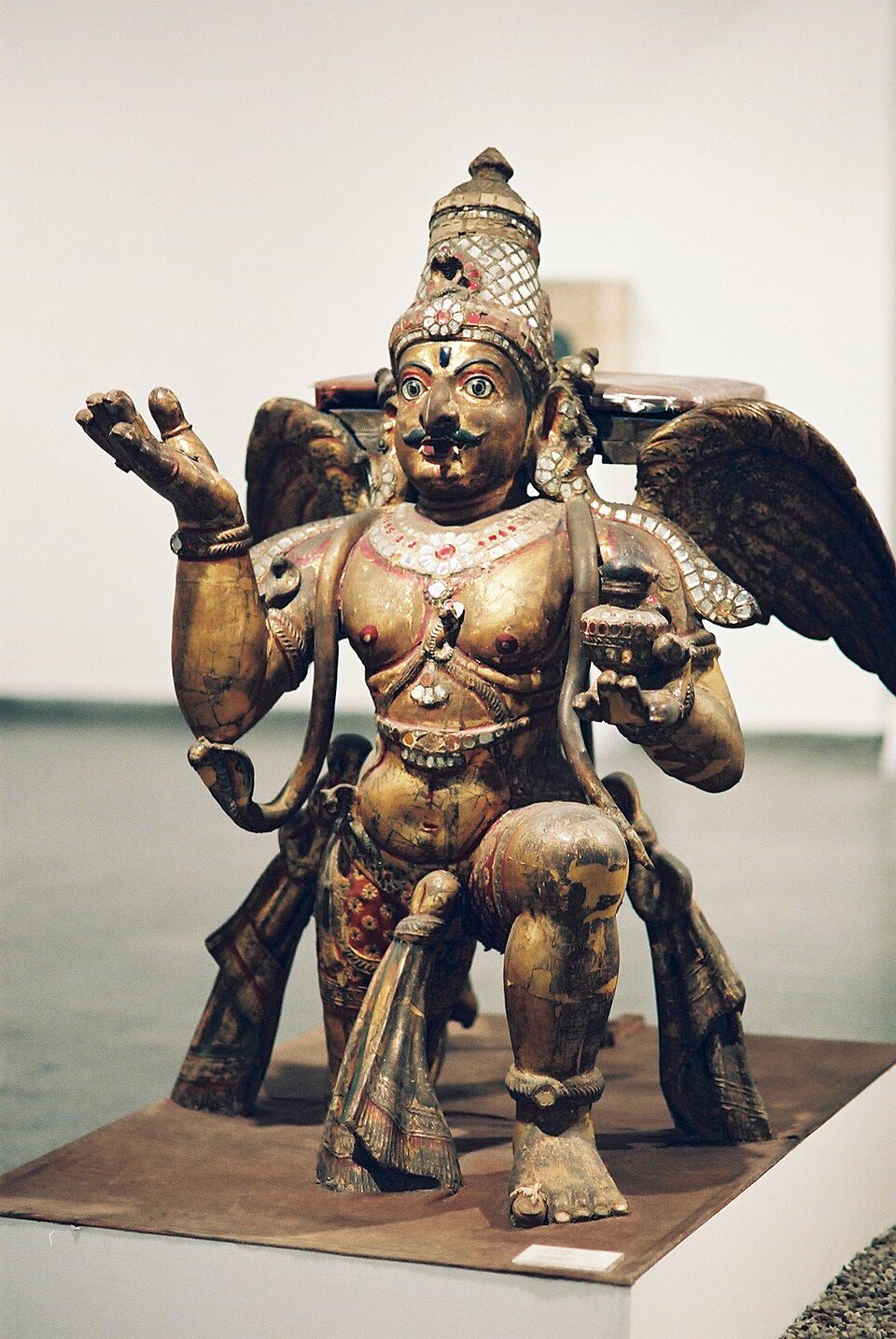
Introduction
According to the Puranas, particularly the Garuda Purana, his origin is deeply intertwined with a saga of filial piety and incredible strength. Born to the sage Kashyapa and Vinata, Garuda's life was defined by his quest to liberate his mother from the servitude of her sister Kadru, the mother of serpents. To secure the nectar of immortality (Amrita) to buy their freedom, Garuda had to face insurmountable celestial challenges, eventually winning the favor of Lord Vishnu himself. This legend establishes him not just as a creature of immense power, but as a being of supreme righteousness (Dharma) and unstoppable willpower.
In scriptural contexts, Garuda is described as the enemy of serpents (Nagas), a duality that symbolizes the triumph of celestial light and solar energy over the terrestrial and chthonic forces of the underworld. His wings are said to be so vast that their flapping can cause the cosmic oceans to churn and the heavens to tremble. He is the embodiment of the Vedas, with his cries representing the sacred sounds of the universe. When Garuda flies, he carries the weight of the entire universe, symbolizing the capacity of a realized soul to support the cosmic order through devotion.
Culturally, Garuda is a central figure in both Vaishnavism and broader Hindu iconography. He is found in the temple architecture of almost every Vishnu shrine, often guarding the entrance or positioned near the sanctum sanctorum. To a newcomer, understanding Garuda is essential to understanding the relationship between the Divine (the Lord) and the Devotee (the Vahana). He teaches us that through intense discipline, courage, and absolute surrender to the Divine, even the most impossible obstacles can be overcome, and the ultimate liberation can be attained.
Significance
Philosophically, the relationship between Vishnu and Garuda is a profound metaphor for the union of the Absolute and the Individual. While Vishnu is the unmoving, eternal reality, Garuda is the dynamic force that carries that reality through the cycles of time. He represents the intellect (Buddhi) that is sharpened and directed toward the Divine. The constant battle between Garuda and the Nagas (serpents) symbolizes the eternal struggle between higher consciousness (the bird/sky) and lower instincts/ego (the serpent/earth). By honoring Garuda, one seeks to elevate their consciousness above base desires.
In the realm of astrology and cosmic energy, Garuda is associated with the Sun and the element of Air. He is considered a protector against 'Sarpa Dosha' (afflictions related to serpents/Rahu/Ketu) and is invoked to remove obstacles related to health, toxins, and sudden calamities. His presence is thought to cleanse the atmosphere of negative energies, much like the eagle cleanses the sky. Devotees often pray to Garuda when they feel stuck in life, seeking the 'flight' necessary to break free from stagnant circumstances.
Culturally and ritually, the Garuda Purana is one of the most influential texts, traditionally recited during the period of mourning to explain the journey of the soul after death. This highlights Garuda's role as a psychopomp—a guide of souls—ensuring that the transition from the physical to the spiritual realm is understood. His veneration is a reminder of the strength found in duty (Dharma) and the transformative power of selfless service. Whether through the chanting of his names or the observation of specific fasts, the remembrance of Garuda empowers the devotee with courage and spiritual clarity.
Best Time to Recite
Find your exact auspicious time Check the shubh muhurat and choghadiya for your city and date.
How to Recite
- 1Begin by lighting the lamp and offering prayers to Lord Ganesha to remove obstacles.
- 2Invoke Lord Vishnu, as Garuda is his inseparable companion; offering prayers to Vishnu completes the energy of Garuda.
- 3Offer sandalwood paste and yellow flowers to the image of Garuda.
- 4Recite the Garuda Mantras with deep focus, visualizing his golden wings spreading across the cosmos.
- 5Perform 'Prana Pratishta' mentally, inviting the essence of Garuda into your consciousness.
- 6Offer Naivedya (food offerings like fruits or sweets) to the deity.
- 7Perform Arati with a camphor flame, circling it in a clockwise motion.
- 8Conclude with a prayer for strength, protection, and the ability to overcome mental and physical obstacles.
Mantras
Garuda Moola Mantra
ॐ गरुडाय नमः
Om Garudaya Namaha
Meaning: Salutations to the Divine Garuda.
Garuda Gayatri Mantra
ॐ वज्रभासने विद्महे सुवर्णपंखाय धीमहि तन्नो गरुड़ः प्रचोदयात्
Om Vajrabhasane Vidmahe Suvarnapankhaya Dhimahi Tanno Garudaha Prachodayat
Meaning: Om, let us meditate on the one who shines like a diamond. May the one with golden wings illuminate our intellect and guide us.
Do's
- ✓Focus on the upward movement of your breath during meditation.
- ✓Show respect to all birds and creatures of the sky.
- ✓Practice discipline and punctuality in your daily routine.
- ✓Visualize golden light during your prayers.
Don'ts
- ✗Do not consume intoxicants during the period of worship.
- ✗Avoid excessive anger or aggression, as these cloud the 'eagle-eye' clarity of the mind.
- ✗Do not perform the ritual in an impure or untidy environment.
- ✗Avoid discussing negative or fearful topics during meditation.
Common Mistakes to Avoid
- •Focusing only on the 'enemy of snakes' aspect without understanding the spiritual triumph of light over darkness.
- •Neglecting the worship of Lord Vishnu while praying to Garuda.
- •Treating the practice as a mere magical ritual rather than a path of devotion and character building.
- •Performing the ritual without proper purification (Shaucha).
Frequently Asked Questions
Why is Garuda the enemy of snakes?▾
Can praying to Garuda help with fear?▾
Is Garuda a separate God?▾
Popular Tools
References & Traditional Notes
- •The Garuda Purana is the primary scriptural source regarding his life and the soul's journey.
- •In Vaishnava Agamas, Garuda is treated as an essential element of the divine service (Kainkarya).
- •Customs may differ based on whether one follows Sri Vaishnavism or other traditions.
Related Audio & Bhajans
Spiritual Journey
The Stages of Spiritual Growth
Diwali Festival & Spirituality
Story Prahlad Holika Symbol Victory Lord Vishnu story|mythology|festival
Shop Pooja & Festive Essentials on Flipkart
Clicking opens Flipkart via our affiliate link. Prices and availability may vary.
Shop on FlipkartCueLinks Publisher: 300371
Shop Festive Wear on Myntra
Clicking opens Myntra via our affiliate link. Prices and availability may vary.
CueLinks Publisher: 300371
Need a website? Describe it, and AI builds it.
Perfect for a temple, pooja service, astrology practice or small shop. Tell the AI what you want — or drag and drop the classic way — and go live on your own web address in minutes with Sitova. Hosting, SEO, forms and analytics are all included.
- Build with AI or drag & drop
- Your domain + SEO built in
- Free forever plan
Opens sitova.site