
Gokarna Mahabaleshwara Temple: The Sacred Atmalinga and Coastal Pilgrimage
Discover the spiritual essence of Gokarna Mahabaleshwara Temple, the legend of the Atmalinga, and the sacred beach pilgrimage of the Arabian Sea coast.
Affiliate disclosure: Sanatan Hindu participates in the Amazon Associates Programme and the CueLinks affiliate network (Myntra & Flipkart). This page contains affiliate links, if you click and buy, we earn a small commission at no extra cost to you. As an Amazon Associate we earn from qualifying purchases. Full disclosure.
Next Maha Shivaratri
Saturday, 6 March 2027· in 139 days
Set a reminder so you never miss Maha Shivaratri.
Introduction
The legend of the Atmalinga is central to the identity of Gokarna. It is said that Ravana, the king of Lanka, performed intense penance to obtain the Atmalinga—the very soul of Lord Shiva—from the deity himself. Ravana sought this power to become invincible. However, through the intervention of Lord Ganesha, who took the form of a young cowherd, the Linga was placed upon the earth at Gokarna to prevent Ravana from carrying it away to Lanka. The Linga was so powerful that it became anchored to the ground, and Ravana, unable to move it, could only worship it from a distance, leaving the sacred relic to bless the earth at this holy site. This tale highlights themes of ego, divine will, and the inescapable nature of cosmic law.
Spiritually, Gokarna is recognized as one of the 'Sapta Puri' (seven holiest cities) in Hinduism, making it a destination of immense merit. The geography of the town is uniquely integrated with its spirituality; the presence of the Arabian Sea provides a natural cleansing element, where the waves are seen as the rhythmic breathing of the ocean deity. The proximity of the temple to the coastline creates a unique pilgrimage experience where the 'Tirtha' (holy water) of the sea complements the 'Abhisheka' (ritual bathing) of the Linga. For a newcomer, Gokarna represents a journey from the chaotic material world to the stillness of the inner self, mirrored by the movement from the crashing waves to the silent sanctum sanctorum.
Culturally, the temple follows the Agamic traditions and serves as a focal point for various Shaivite traditions. The atmosphere is thick with the scent of camphor, sandalwood, and incense, accompanied by the rhythmic chanting of Vedic hymns. Whether one is a devout practitioner or a seeker of historical depth, the Mahabaleshwara temple offers a layered experience of history, mythology, and profound stillness. It is a place where the veil between the physical and the metaphysical is perceived to be exceptionally thin, inviting every pilgrim to look within and find their own 'Atma' (soul) through the grace of Mahabaleshwara.
Significance
From a Puranic perspective, the temple is a site of immense 'Punya' (spiritual merit). It is believed that a pilgrimage to Gokarna, especially involving the ritual bathing in the sea and the subsequent darshan of the Linga, can wash away the deep-seated 'Sanchita Karma' (accumulated past actions). The specific topography of Gokarna—the 'Gokarna Kshetra'—is considered a sacred geometry where the energies of the earth and sea converge. This makes it an auspicious place for those seeking clarity, purification, and the resolution of karmic debts.
Astrologically and cosmically, the site is linked to the stabilization of planetary energies. Many practitioners believe that performing rituals at Gokarna helps in mitigating the malefic effects of Saturn (Shani) and Rahu, as Shiva is the master of time (Mahakala) and the cosmic order. The temple is also a vital part of the 'Kashi-Ayodhya-Mathura-Gokarna' circuit, which forms a spiritual backbone for North and South Indian pilgrimage routes, connecting different geographical and cultural spheres of Hinduism.
Furthermore, the temple serves as a cultural repository for the traditions of the coastal Karnataka region. The rituals, the architecture, and the festivals celebrated here reflect a harmonious blend of Vedic orthodoxy and local folk traditions. For the community, the temple is the heartbeat of social and spiritual life, where the cycles of the moon and the seasons dictate the rhythm of worship. The 'Phala' (fruit) of visiting this shrine is described in various texts as the attainment of 'Shanti' (peace), 'Bhukti' (worldly prosperity), and 'Mukti' (spiritual liberation), catering to the holistic needs of the human experience.
Auspicious Time
Find your exact auspicious time Check the shubh muhurat and choghadiya for your city and date.
Required Samagri (Materials)
Preparation Steps
- 1Perform personal purification (snana) with the intention of sanctity.
- 2Wear clean, traditional clothing (Dhoti for men, Saree/Salwar for women).
- 3Fast or consume light, Satvic food prior to the pilgrimage.
- 4Meditate on Lord Shiva to center the mind before entering the temple premises.
- 5Ensure you have the necessary offerings prepared if you intend to perform a specific pooja via a priest.
Steps
- 1Step 1: Perform 'Sankalpa'—take water in your hand and state your name, lineage, and your intention for the pilgrimage.
- 2Step 2: Take a holy dip in the Arabian Sea at Gokarna beach to cleanse the physical body.
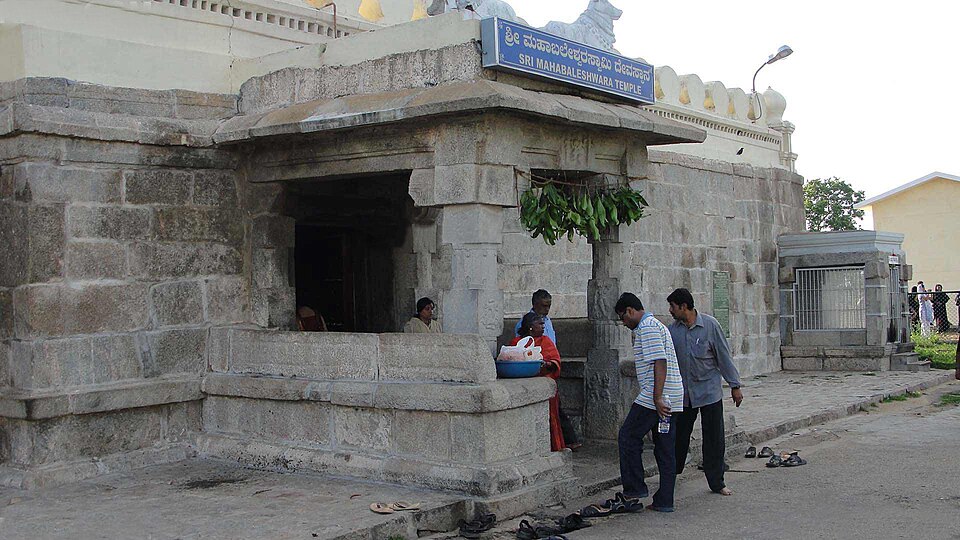
- 3Step 3: Enter the Mahabaleshwara temple with reverence, removing footwear as per local custom.
- 4Step 4: Perform 'Pradakshina' (circumambulation) of the temple sanctum in a clockwise direction.
- 5Step 5: Offer Bilva leaves to the Atmalinga, ensuring the three leaflets are intact.
- 6Step 6: If performing Abhisheka, offer milk, honey, and water over the Linga while chanting the Panchakshari Mantra.
- 7Step 7: Light a camphor lamp and offer prayers to the deity.
- 8Step 8: Sit in silent meditation for a few moments to absorb the spiritual vibrations of the sanctum.
Mantras
Panchakshari Mantra
ॐ नमः शिवाय
Om Namah Shivaya
Meaning: I bow to Lord Shiva (the auspicious one).
Mahamrityunjaya Mantra
ॐ त्र्यम्बकं यजामहे सुगन्धिं पुष्टिवर्धनम्। उर्वारुकमिव बन्धनान्मृत्योर्मुक्षीय माऽमृतात्॥
Om Tryambakam Yajamahe Sugandhim Pushti-Vardhanam | Urvarukamiva Bandhanan Mrityor Mukshiya Maamritat ||
Meaning: We worship the Three-Eyed One (Lord Shiva), who is fragrant and nourishes all beings. As the cucumber is freed from its bond to the vine, may He liberate us from death for the sake of immortality.
Guidelines
- •Maintain strict celibacy (Brahmacharya) during the pilgrimage.
- •Follow a Satvic diet (avoid onion, garlic, and non-vegetarian food).
- •Practice silence (Mauna) where possible to conserve spiritual energy.
- •Avoid harsh speech or anger towards fellow pilgrims.
Do's
- ✓Offer Bilva leaves to the Shiva Linga.
- ✓Bathe in the sea before temple entry.
- ✓Respect the local customs and dress codes.
- ✓Participate in the evening Aarti if possible.
Don'ts
- ✗Do not enter the inner sanctum if forbidden by local tradition.
- ✗Do not take photographs inside the main shrine unless explicitly permitted.
- ✗Do not touch the Linga directly if you are not a designated priest.
- ✗Avoid loud conversations within the temple complex.
Common Mistakes to Avoid
- •Attempting to perform Abhisheka without the guidance of a temple priest.
- •Ignoring the importance of the sea bath, which is a vital part of the Gokarna tradition.
- •Treating the pilgrimage as a mere tourist excursion rather than a spiritual journey.
- •Failing to respect the specific dress codes of the temple.
Regional Variations
- •In some South Indian traditions, specific types of flowers are preferred, while in North Indian traditions, different offerings might be common.
- •The method of performing the sea bath may vary between different family lineages (Sampradayas).
- •Ritual timings might differ slightly based on the local temple administration's Agamic adherence.
Frequently Asked Questions
Can anyone perform Abhisheka to the Atmalinga?▾
Is there a dress code for the temple?▾
What is the significance of the sea in Gokarna?▾
Popular Tools
References & Traditional Notes
- •The legends are primarily derived from the Skanda Purana.
- •Local traditions are governed by the specific Agamas followed by the temple priests.
- •The importance of the 'Gokarna Kshetra' is documented in various Shaivite literature.
Related Audio & Bhajans
Affiliate disclosure: Sanatan Hindu participates in the Amazon Associates Programme and the CueLinks affiliate network (Myntra & Flipkart). This page contains affiliate links, if you click and buy, we earn a small commission at no extra cost to you. As an Amazon Associate we earn from qualifying purchases. Full disclosure.
Shop Samagri on Amazon.in
Clicking opens Amazon.in. Prices and availability may vary.
Browse all pooja itemsAmazon Associates tag: geekydevelope-21
Shop Pooja & Festive Essentials on Flipkart
Clicking opens Flipkart via our affiliate link. Prices and availability may vary.
Shop on FlipkartCueLinks Publisher: 300371
Shop Festive Wear on Myntra
Clicking opens Myntra via our affiliate link. Prices and availability may vary.
CueLinks Publisher: 300371
Need a website? Describe it, and AI builds it.
Perfect for a temple, pooja service, astrology practice or small shop. Tell the AI what you want — or drag and drop the classic way — and go live on your own web address in minutes with Sitova. Hosting, SEO, forms and analytics are all included.
- Build with AI or drag & drop
- Your domain + SEO built in
- Free forever plan
Opens sitova.site