
Hatha Yoga: Physical Practices for Spiritual Awakening
Comprehensive guide to Hatha Yoga — asanas, pranayama, mudras, and bandhas for purifying body and mind to awaken higher consciousness.
Affiliate disclosure: Sanatan Hindu participates in the Amazon Associates Programme and the CueLinks affiliate network (Myntra & Flipkart). This page contains affiliate links, if you click and buy, we earn a small commission at no extra cost to you. As an Amazon Associate we earn from qualifying purchases. Full disclosure.
Next Maha Shivaratri
Saturday, 6 March 2027· in 182 days
Set a reminder so you never miss Maha Shivaratri.
Introduction
The historical roots of Hatha Yoga trace back to the tantric traditions of medieval India, particularly the Nath Sampradaya founded by the great yogi Gorakhnath (circa 9th–11th century CE), who is considered a direct disciple of Matsyendranath, the legendary founder of the Kaula lineage. The most authoritative classical texts on Hatha Yoga — the Hatha Yoga Pradipika (compiled by Svatmarama in the 15th century), the Gheranda Samhita (17th century), and the Shiva Samhita (17th–18th century) — systematically codify these practices, presenting them as a preparatory ladder (sopana) for Raja Yoga, the royal path of meditation and samadhi as expounded by Patanjali in the Yoga Sutras. These texts emphasize that without a purified, stable, and disease-free body, the mind cannot be stilled, and the subtle energies cannot be directed upward. Thus, Hatha Yoga is not an end in itself but a necessary foundation (adhara) for the ultimate goal of yoga: kaivalya (liberation) or union with the Divine.
Legend attributes the origin of Hatha Yoga to Lord Shiva himself, the Adi Yogi (first yogi), who imparted this knowledge to his consort Parvati on a secluded island. According to the Shiva Samhita, Shiva revealed the science of Hatha Yoga to Parvati for the benefit of humanity in the Kali Yuga, when intellectual capacities are diminished and people require tangible, body-based methods to access spiritual truths. The knowledge was then passed down through the lineage of Matsyendranath and Gorakhnath, who systematized it for householders and renunciates alike. This divine origin underscores the sacred nature of the practice: every asana, every breath, every mudra is considered an offering to the indwelling Shiva-consciousness. The practices were traditionally guarded and transmitted only through guru-shishya parampara (teacher-student lineage), ensuring correct understanding and safe application.
In the broader cultural and spiritual context of India, Hatha Yoga has always been intertwined with Ayurveda, the science of life, sharing the same philosophical framework of the three doshas (vata, pitta, kapha), the five elements (pancha mahabhutas), and the concept of agni (digestive/metabolic fire). The shatkarmas (six purificatory actions) — neti, dhauti, basti, nauli, trataka, and kapalabhati — are direct applications of Ayurvedic principles to cleanse the nadis (energy channels) and remove accumulated toxins (ama). Moreover, Hatha Yoga was historically practiced by sadhus, sannyasis, and householders as part of daily dinacharya (routine) to maintain health, longevity, and mental clarity for spiritual pursuits. In temples and mathas (monasteries), specific sequences were performed before deity worship to align the worshiper's energy with the divine. Today, while Hatha Yoga has spread globally in countless forms — from therapeutic applications to fitness-oriented styles — its core remains a sacred technology for self-transformation, rooted in the vision of the rishis who saw the body not as an obstacle but as a temple of the Divine.
For a newcomer, it is essential to understand that Hatha Yoga is not merely gymnastics or stress relief, though it certainly provides those benefits. It is a systematic methodology to harmonize the annamaya kosha (physical sheath), pranamaya kosha (energy sheath), and manomaya kosha (mental sheath), creating the conditions for the vijnanamaya kosha (wisdom sheath) and anandamaya kosha (bliss sheath) to be experienced. The practices are progressive: one begins with gross physical purification, moves to subtle breath regulation, then to the manipulation of pranic forces through mudras and bandhas, and finally to deep meditative absorption. Each stage prepares the ground for the next. Approaching Hatha Yoga with reverence, patience, and guidance from a qualified teacher ensures that the practitioner reaps not only physical vitality but the profound spiritual fruits for which this ancient science was designed.
Significance
From a religious and devotional perspective, Hatha Yoga is deeply connected to Shaivism and the worship of Shiva as the Lord of Yoga (Yogeshwara). Many asanas are named after sages, animals, or divine forms, reflecting the belief that by assuming these postures, the practitioner invokes the qualities of those beings. For example, Matsyendrasana honors the sage Matsyendranath, while Virabhadrasana embodies the fierce warrior form of Shiva. The practice of Surya Namaskara (Sun Salutation) is a moving prayer to Surya Narayana, the visible form of the Divine, integrating mantra, breath, and movement. In many traditions, Hatha Yoga is performed as seva (service) to the indwelling deity, with each breath offered as a sacrifice (yajna) into the fire of prana. The Gheranda Samhita (1.10) declares: "There is no success in yoga without Hatha Yoga, and no success in Hatha Yoga without Raja Yoga; therefore, one should practice both completely." This interdependence highlights that Hatha Yoga is not a separate path but the essential foundation (upaya) for all higher yogic attainments.
Culturally, Hatha Yoga has been a cornerstone of Indian physical education and preventive healthcare for centuries. The shatkarmas, in particular, represent a sophisticated system of internal hygiene that aligns with Ayurvedic seasonal routines (ritucharya) and daily regimens (dinacharya). Families traditionally taught children simple practices like neti (nasal cleansing), kapalabhati (skull-shining breath), and basic asanas to build immunity, improve digestion, and enhance concentration for studies. In the gurukula system, students practiced yoga daily to cultivate discipline, memory, and moral character. Even today, in rural India, many households observe morning yoga as a sacred family ritual, often accompanied by chanting of the Gayatri Mantra or Om. The global spread of yoga since the 20th century, spearheaded by teachers like T. Krishnamacharya, B.K.S. Iyengar, Pattabhi Jois, and Swami Sivananda, has made Hatha Yoga a cultural ambassador of India, though often stripped of its spiritual depth. Reclaiming its full significance requires reintegrating the ethical precepts (yamas and niyamas), the devotional attitude (ishvara pranidhana), and the goal of self-knowledge (atma jnana).
Astrologically and energetically, Hatha Yoga is considered most potent when practiced during Brahma Muhurta (approximately 96 minutes before sunrise), when the atmosphere is saturated with sattva guna, the mind is naturally calm, and the vata dosha predominates, facilitating movement and subtle perception. The phases of the moon also influence practice: full moon (purnima) and new moon (amavasya) are traditionally observed as rest days or days for gentle practice only, as the gravitational pull affects the body's fluids and pranic flow, increasing the risk of injury or imbalance. Certain asanas are recommended or avoided based on one's constitutional type (prakriti) and current imbalances (vikriti), reflecting the Ayurvedic principle of individualized practice. The phala (fruits) of consistent Hatha Yoga sadhana, as enumerated in the Hatha Yoga Pradipika (1.17), include: "lightness of body, health, steadiness, clarity of countenance, sweetness of voice, purity of nadis, and mastery over the senses." Ultimately, the highest fruit is the awakening of Kundalini and the attainment of samadhi, where the individual self (jivatman) merges with the universal Self (Paramatman). This promise of liberation (moksha) through embodied practice makes Hatha Yoga a unique and powerful path in the Hindu spiritual tradition.
Auspicious Time
Find your exact auspicious time Check the shubh muhurat and choghadiya for your city and date.
Required Samagri (Materials)
Preparation Steps
- 1Empty bowels and bladder; perform morning hygiene (snana) if possible.
- 2Clean the practice space; ensure good ventilation and a calm atmosphere.
- 3Lay the mat on a flat, firm surface; place a folded blanket for seated postures if needed.
- 4Wear loose, modest clothing that allows free movement; remove jewelry, watches, glasses.
- 5Set a clear intention (sankalpa) for the practice: health, purification, spiritual growth.
- 6Sit quietly for a few minutes, observe natural breath, center the mind.
- 7Chant the opening mantra (Om or Guru mantra) to invoke guidance and protection.
Steps
- 11. Shatkarmas (Purificatory Practices — optional, 2–3 times per week): Perform Jala Neti (nasal irrigation with saline water) to cleanse nasal passages; follow with Kapalabhati (skull-shining breath) for 3 rounds of 30–50 strokes to clear frontal sinuses and energize. If trained, practice Nauli (abdominal churning) for digestive fire.
- 22. Sukshma Vyayama (Subtle Joint Movements): Begin with gentle rotations of ankles, knees, hips, wrists, elbows, shoulders, and neck — 5–10 repetitions each — to lubricate joints and awaken proprioception.
- 33. Surya Namaskara (Sun Salutation): Perform 6–12 rounds of classical Surya Namaskara (12-step sequence), synchronizing each movement with breath (inhale for expansion, exhale for contraction). Chant the 12 Surya mantras (Om Mitraya Namaha, etc.) if known.
- 44. Standing Asanas: Practice Tadasana (Mountain), Vrikshasana (Tree), Trikonasana (Triangle), Virabhadrasana I & II (Warrior), Parsvakonasana (Side Angle) — hold each for 5–8 breaths, focusing on alignment, grounding, and drishti (gaze point).
- 55. Seated and Supine Asanas: Move to Dandasana (Staff), Paschimottanasana (Seated Forward Bend), Janu Sirsasana (Head-to-Knee), Baddha Konasana (Bound Angle), Supta Padangusthasana (Reclining Hand-to-Big-Toe), Setu Bandha Sarvangasana (Bridge) — hold 30–60 seconds each, breathing deeply.
- 66. Inversions (if no contraindications): Salamba Sarvangasana (Supported Shoulderstand) for 3–5 minutes, followed by Halasana (Plow) and Matsyasana (Fish) as counterpose. Alternatively, Viparita Karani (Legs-up-the-Wall) for gentle inversion.
- 77. Prone Asanas: Bhujangasana (Cobra), Shalabhasana (Locust), Dhanurasana (Bow) — strengthen back, open chest, stimulate manipura chakra.
- 88. Twists: Ardha Matsyendrasana (Half Lord of the Fishes) on each side — detoxify spine, massage abdominal organs.
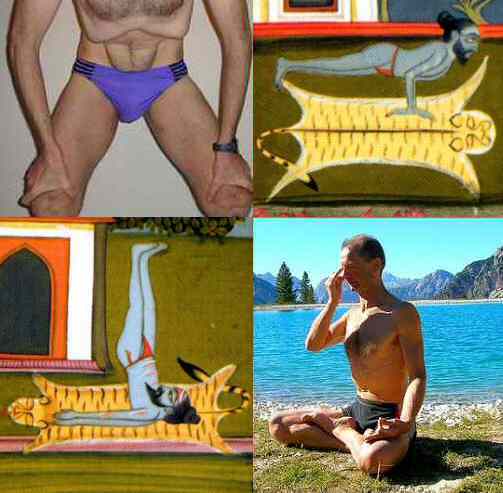
- 99. Pranayama (Breath Regulation): Sit in Padmasana, Siddhasana, or Sukhasana with spine erect. Practice Nadi Shodhana (Alternate Nostril Breathing) for 10–15 rounds (1:4:2 ratio if advanced), then Bhramari (Humming Bee Breath) for 5–7 rounds, ending with Ujjayi (Victorious Breath) for 3–5 minutes.
- 1010. Mudras and Bandhas: Perform Maha Mudra (Great Seal) and Maha Bandha (Great Lock — combining Jalandhara, Uddiyana, and Moola Bandhas) for 3–5 rounds to direct prana into Sushumna.
- 1111. Shavasana (Corpse Pose): Lie supine, arms 45°, palms up, feet apart. Systematically relax every body part from toes to crown. Remain for 10–15 minutes; practice Yoga Nidra (guided relaxation) if desired.
- 1212. Meditation (Dhyana): Sit again in a comfortable meditative posture. Practice breath awareness, mantra japa (e.g., Om or So'ham), or chakra meditation for 10–20 minutes.
- 1313. Closing: Bring hands to Anjali Mudra at heart center. Chant closing mantra (Om Shanti Shanti Shanti). Offer gratitude to guru, lineage, and the Divine. Rise slowly, drink warm water.
Mantras
Opening Mantra — Om
ॐ
Om
Meaning: The primordial sound representing the ultimate reality, Brahman; invocation of the Divine presence within and without.
Guru Mantra
गुरुर्ब्रह्मा गुरुर्विष्णुः गुरुर्देवो महेश्वरः। गुरुः साक्षात् परब्रह्म तस्मै श्रीगुरवे नमः॥
Gurur Brahma Gurur Vishnu Gurur Devo Maheshwarah। Guru Sakshat Parabrahma Tasmai Shri Gurave Namah॥
Meaning: The Guru is Brahma (creator), Vishnu (preserver), Shiva (transformer); the Guru is the Supreme Brahman itself. Salutations to that Guru.
Surya Namaskara Mantras (12 Names of Sun)
ॐ मित्राय नमः। ॐ रवये नमः। ॐ सूर्याय नमः। ॐ भानवे नमः। ॐ खगाय नमः। ॐ पूष्णे नमः। ॐ हिरण्यगर्भाय नमः। ॐ मरीचये नमः। ॐ आदित्याय नमः। ॐ सवित्रे नमः। ॐ अर्काय नमः। ॐ भास्कराय नमः।
Om Mitraya Namaha। Om Ravaye Namaha। Om Suryaya Namaha। Om Bhanave Namaha। Om Khagaya Namaha। Om Pushne Namaha। Om Hiranyagarbhaya Namaha। Om Marichaye Namaha। Om Adityaya Namaha। Om Savitre Namaha। Om Arkaya Namaha। Om Bhaskaraya Namaha।
Meaning: Salutations to the Sun as Friend, Shining One, Source of Life, Illuminator, Sky-Dweller, Nourisher, Golden-Wombed, Ray of Light, Son of Aditi, Stimulator, Radiant One, Light-Maker.
Closing Mantra — Om Shanti
ॐ शान्तिः शान्तिः शान्तिः
Om Shantih Shantih Shantih
Meaning: Om, peace, peace, peace — invoking peace at the physical, mental, and spiritual levels.
Guidelines
- •Practice regularly (daily or at least 5 days a week) at the same time for consistency.
- •Maintain a sattvic diet: fresh, vegetarian, moderate in quantity; avoid tamasic foods (stale, processed, intoxicants).
- •Observe brahmacharya (celibacy/moderation in sensual pleasures) to conserve ojas (vital essence).
- •Sleep early (by 10 PM) and rise before sunrise to align with natural rhythms.
- •Fast on Ekadashi (11th lunar day) or at least eat light, fruit-based meals to support purification.
- •Speak truth, practice non-violence (ahimsa), and cultivate contentment (santosha) in daily life.
Do's
- ✓Practice on an empty stomach (3–4 hours after meals).
- ✓Breathe through the nose unless instructed otherwise.
- ✓Move slowly and mindfully; never jerk or force into a posture.
- ✓Maintain steady, rhythmic breath throughout asanas; never hold breath unless in specific pranayama.
- ✓Use props (blocks, straps, blankets) to support alignment and prevent strain.
- ✓Listen to your body; distinguish between beneficial stretch and harmful pain.
- ✓Keep the gaze (drishti) focused to steady the mind.
- ✓End every session with Shavasana and meditation.
Don'ts
- ✗Do not practice inverted postures during menstruation, high blood pressure, glaucoma, or cervical issues.
- ✗Do not practice immediately after eating, in extreme heat/cold, or when exhausted/ill.
- ✗Do not compare your practice with others; yoga is an inner journey.
- ✗Do not skip warm-up or cool-down; they prevent injury and integrate benefits.
- ✗Do not hold breath in asanas (except in specific bandha practice under guidance).
- ✗Do not practice advanced mudras/bandhas without a qualified teacher.
- ✗Do not treat yoga as mere exercise; honor its spiritual dimension.
Common Mistakes to Avoid
- •Rushing through asanas without breath awareness.
- •Collapsing the lower back in forward bends or backbends.
- •Holding tension in shoulders, jaw, or face during practice.
- •Practicing only favorite poses, neglecting counterposes and balance.
- •Inconsistent practice — expecting results from sporadic effort.
- •Ignoring the ethical foundation (yamas/niyamas) while focusing only on physical feats.
- •Practicing pranayama incorrectly (e.g., forced retention, mouth breathing).
- •Skipping Shavasana, leading to overstimulation and fatigue.
Regional Variations
- •North India (Hatha Yoga Pradipika tradition): Emphasis on shatkarmas, long holds in asanas, and systematic pranayama with bandhas.
- •South India (Krishnamacharya lineage): Vinyasa krama (sequential linking of breath and movement), individualized therapy (Yoga Chikitsa), use of props.
- •Bengal/Nath Tradition: Focus on Kundalini awakening through intense mudras, bandhas, and mantra; often practiced in secrecy.
- •Gujarat/Swaminarayan Tradition: Integration of devotional bhajan with asana; emphasis on discipline and community practice.
- •Western Adaptations (Iyengar, Ashtanga, Sivananda, Bikram): Standardized sequences, alignment precision, heated rooms, or fixed series — often de-emphasizing shatkarmas and meditation.
Frequently Asked Questions
Is Hatha Yoga suitable for beginners?▾
How is Hatha Yoga different from Vinyasa or Ashtanga?▾
Can I practice Hatha Yoga during pregnancy?▾
Do I need to be flexible to start Hatha Yoga?▾
What is the role of a guru in Hatha Yoga?▾
Popular Tools
References & Traditional Notes
- •Hatha Yoga Pradipika by Svatmarama (15th century) — primary text on asana, shatkarma, pranayama, mudra, bandha, samadhi.
- •Gheranda Samhita (17th century) — encyclopedic text detailing 32 asanas, 25 mudras, and a sevenfold path (shatkarma, asana, mudra, pratyahara, pranayama, dhyana, samadhi).
- •Shiva Samhita (17th–18th century) — dialogue between Shiva and Parvati; integrates tantra, kundalini, and yoga philosophy.
- •Patanjali Yoga Sutras (circa 200 BCE–400 CE) — philosophical foundation; Hatha Yoga prepares for the eight limbs (ashtanga) culminating in samadhi.
- •Ayurvedic texts (Charaka Samhita, Sushruta Samhita) — shared principles of dosha, dhatu, mala, agni; inform shatkarma and dietary guidelines.
- •Goraksha Samhita / Goraksha Paddhati — attributed to Gorakhnath; early text on Hatha Yoga techniques and philosophy.
- •Modern lineage holders: T. Krishnamacharya (father of modern yoga), B.K.S. Iyengar (alignment, props), Pattabhi Jois (Ashtanga Vinyasa), Swami Sivananda (integral yoga), Swami Satyananda Saraswati (Bihar School).
Related Audio & Bhajans
Om Jai Shiv Omkara - Shiv Aarti
Om Namah Shivay Dhun
Spiritual Journey
Introduction
The Stages of Spiritual Growth
Diwali Festival & Spirituality
Shiva Stotras and Mantras
Affiliate disclosure: Sanatan Hindu participates in the Amazon Associates Programme and the CueLinks affiliate network (Myntra & Flipkart). This page contains affiliate links, if you click and buy, we earn a small commission at no extra cost to you. As an Amazon Associate we earn from qualifying purchases. Full disclosure.
Shop Samagri on Amazon.in
Clicking opens Amazon.in. Prices and availability may vary.
Browse all pooja itemsAmazon Associates tag: geekydevelope-21
Shop Pooja & Festive Essentials on Flipkart
Clicking opens Flipkart via our affiliate link. Prices and availability may vary.
Shop on FlipkartCueLinks Publisher: 300371
Shop Festive Wear on Myntra
Clicking opens Myntra via our affiliate link. Prices and availability may vary.
CueLinks Publisher: 300371