
Kapalbhati Pranayama: The Sacred Art of Skull-Shining Breathwork
Master Kapalbhati Pranayama with this comprehensive guide on its Vedic origins, sacred techniques, spiritual significance, and profound physiological benefits.
Affiliate disclosure: Sanatan Hindu participates in the Amazon Associates Programme and the CueLinks affiliate network (Myntra & Flipkart). This page contains affiliate links, if you click and buy, we earn a small commission at no extra cost to you. As an Amazon Associate we earn from qualifying purchases. Full disclosure.
Next Maha Shivaratri
Saturday, 6 March 2027· in 179 days
Set a reminder so you never miss Maha Shivaratri.
Introduction
While many contemporary practitioners view Kapalbhati through a purely physiological lens—focusing on carbon dioxide expulsion and abdominal strengthening—its roots are deeply embedded in the spiritual quest for purification. In the classical Hatha Yoga tradition, as outlined in texts like the Hatha Yoga Pradipika, the body is seen as a vessel for the soul. Before one can embark on the profound journey of Raja Yoga or deep meditation, the vessel must be cleansed of 'Malas' (impurities). Kapalbhati serves as a 'Shatkarma' (purificatory action) that prepares the nervous system and the subtle body for higher states of awareness.
Historically, the practice has been passed down through various lineages (Sampradayas), with subtle differences in rhythm, duration, and intent. Some lineages emphasize the vigorous, rapid exhalations to stimulate the digestive fire (Agni), while others approach it with a more rhythmic, meditative quality to stabilize the mind. It is not merely a breathing exercise but a ritualistic cleansing of the frontal brain, intended to bring clarity, focus, and a sense of luminous presence to the practitioner.
In the broader context of Hindu spiritual life, Kapalbhati aligns with the concept of 'Shuddhi' (purification). Just as a lamp must have a clean wick to burn brightly, the human intellect (Buddhi) requires the removal of mental lethargy (Tamas) to function with clarity (Sattva). By engaging the diaphragm and the abdominal muscles in a rhythmic pattern, the practitioner invokes a state of alertness that bridges the gap between the physical body and the subtle energetic currents of the cosmos.
Significance
Spiritually, the practice is deeply connected to the activation of the Ajna Chakra. The rapid movements of the diaphragm create a subtle vibration that travels up the Sushumna Nadi (the central energy channel). This vibration helps in clearing blockages in the subtle channels, allowing the Kundalini energy to rise more freely. When the 'skull shines,' it refers to the sharpening of the intellect and the removal of the veil of Maya (illusion), enabling the practitioner to perceive reality with greater precision and less egoic interference.
In the context of Ayurveda, Kapalbhati is highly regarded for its ability to balance the Doshas, particularly the Kapha Dosha. Kapha is characterized by heaviness, lethargy, and stagnation. The vigorous nature of Kapalbhati acts as a 'fire' that burns through this stagnation, promoting metabolic heat and mental alertness. This physical revitalization is viewed as a precursor to spiritual discipline (Sadhana), as a heavy or sluggish body is a significant hindrance to long periods of seated meditation.
Furthermore, Kapalbhati holds profound psychological significance. It is a powerful remedy for Tamasic states of mind—depression, confusion, and drowsiness. By stimulating the sympathetic nervous system in a controlled manner and subsequently allowing for a deep parasympathetic response, it helps regulate the emotional landscape. For the seeker, this translates to 'Chitta Vritti Nirodha'—the quieting of the fluctuations of the mind. It brings a sense of 'Tejas' (spiritual luster or brilliance) to the countenance, reflecting an internal state of purity and awakened consciousness.
Auspicious Time
Find your exact auspicious time Check the shubh muhurat and choghadiya for your city and date.
Required Samagri (Materials)
Preparation Steps
- 1Ensure you have not eaten for at least 3-4 hours prior to practice.
- 2Find a quiet environment free from distractions.
- 3Wash your hands and face to feel refreshed.
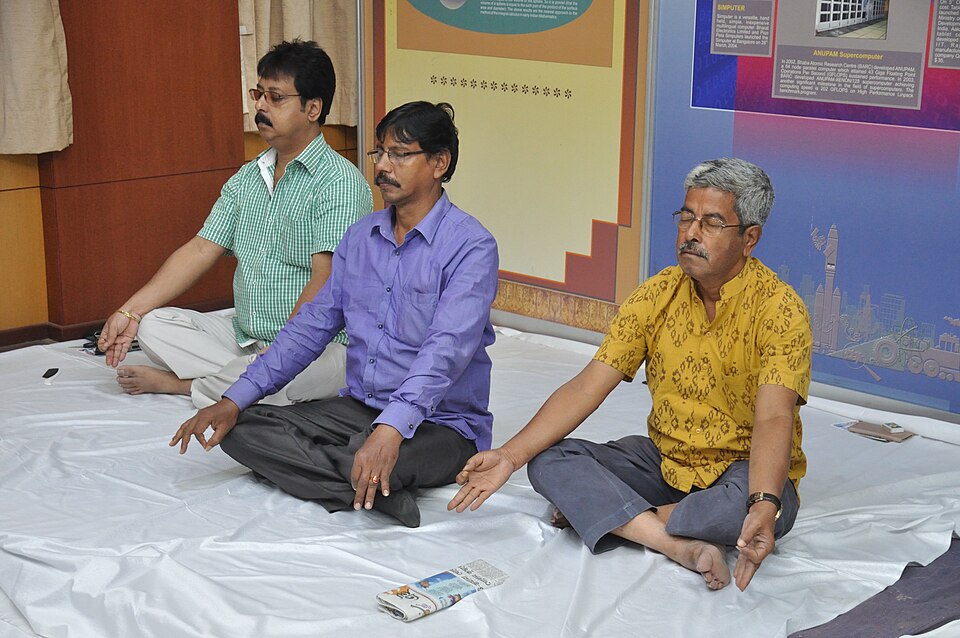
- 4Sit in a stable meditative pose such as Padmasana (Lotus Pose), Siddhasana, or Sukhasana (Easy Pose).
- 5Keep your spine, neck, and head in a straight, vertical line.
Steps
- 1Close your eyes and take several deep, natural breaths to settle the mind.
- 2Place your hands on your knees in Jnana Mudra (index finger touching the thumb).
- 3Inhale deeply through the nose to expand the lungs.
- 4Perform the active phase: Execute a quick, forceful exhalation through the nose by contracting the abdominal muscles sharply towards the spine.
- 5Allow the inhalation to happen passively and automatically; do not force the breath in, simply let the lungs expand as the abdomen relaxes.
- 6Maintain a rhythmic pace, ensuring the exhalation is the only active movement.
- 7Continue this pattern for a set number of rounds (e.g., 20-30 breaths per round).
- 8After completing the rounds, take a deep breath in, hold it for a moment (Kumbhaka), and exhale slowly to experience the stillness.
Mantras
Om Mantra for Purification
ॐ
Om
Meaning: The primordial sound of the universe, used to center the mind before and after practice.
Shanti Mantra
ॐ शान्तिः शान्तिः शान्तिः
Om Shantihi Shantihi Shantihi
Meaning: Om, Peace, Peace, Peace (invoking peace in the body, mind, and spirit).
Guidelines
- •Practice should be done with a sense of 'Sadhana' (disciplined spiritual practice) rather than mere exercise.
- •Maintain silence (Mauna) before and after the practice to preserve the energy generated.
- •Approach the practice with a prayerful attitude toward the Prana.
Do's
- ✓Keep the spine straight throughout the practice.
- ✓Focus your gaze internally on the third eye point.
- ✓Maintain a rhythmic and consistent pace.
- ✓Focus on the contraction of the abdomen, not the chest.
Don'ts
- ✗Do not force the inhalation; let it be passive.
- ✗Do not practice if you are feeling unwell or have high blood pressure.
- ✗Do not perform Kapalbhati while standing or lying down.
- ✗Do not use the chest or shoulders to force the breath.
Common Mistakes to Avoid
- •Forcing the inhalation (this leads to hyperventilation).
- •Moving the chest and shoulders instead of just the abdomen.
- •Holding the breath during the active exhalation phase.
- •Practicing with a full stomach.
Regional Variations
- •In some Hatha Yoga lineages, the pace is extremely rapid to induce a 'kriyic' state.
- •In some Vedantic traditions, it is performed much more slowly as a way to stabilize the breath.
- •Some Acharyas suggest combining it with specific Mudras to direct the energy flow.
Frequently Asked Questions
Can Kapalbhati be practiced daily?▾
Is Kapalbhati a Pranayama or a Shatkarma?▾
Who should avoid Kapalbhati?▾
Popular Tools
References & Traditional Notes
- •Refer to the Hatha Yoga Pradipika for classical cleansing techniques.
- •Note that the intensity of the breath can be adjusted based on the practitioner's stage of development.
- •Always observe the 'Agni' (internal heat) created and avoid over-exertion.
Related Audio & Bhajans
Affiliate disclosure: Sanatan Hindu participates in the Amazon Associates Programme and the CueLinks affiliate network (Myntra & Flipkart). This page contains affiliate links, if you click and buy, we earn a small commission at no extra cost to you. As an Amazon Associate we earn from qualifying purchases. Full disclosure.
Shop Samagri on Amazon.in
Clicking opens Amazon.in. Prices and availability may vary.
Browse all pooja itemsAmazon Associates tag: geekydevelope-21
Shop Pooja & Festive Essentials on Flipkart
Clicking opens Flipkart via our affiliate link. Prices and availability may vary.
Shop on FlipkartCueLinks Publisher: 300371
Shop Festive Wear on Myntra
Clicking opens Myntra via our affiliate link. Prices and availability may vary.
CueLinks Publisher: 300371