
Mangalsutra — Significance of the Sacred Necklace in Hindu Marriage
Explore the profound spiritual, cultural, and symbolic significance of the Mangalsutra, the sacred thread that binds a Hindu marriage together.
Affiliate disclosure: Sanatan Hindu participates in the Amazon Associates Programme and the CueLinks affiliate network (Myntra & Flipkart). This page contains affiliate links, if you click and buy, we earn a small commission at no extra cost to you. As an Amazon Associate we earn from qualifying purchases. Full disclosure.
Next Karwa Chauth
Tuesday, 19 October 2027· in 334 days
Set a reminder so you never miss Karwa Chauth.
Introduction
Scriptural and Puranic roots of this tradition can be traced back to the Vedic era, where the concept of 'Mangala'—auspiciousness—is central to all life transitions. While specific descriptions of the necklace vary across different ancient texts, the essence of tying a sacred thread to signify a bond is deeply embedded in the Vedas and Grihya Sutras. It is often associated with the divine feminine energy, Shakti, symbolizing that the wife is the 'Grihalakshmi' (the goddess of the household) who brings prosperity and well-being to the home. The act of tying the Mangalsutra is a ritualistic sealing of a vow, much like the Saptapadi (seven steps) taken around the holy fire.
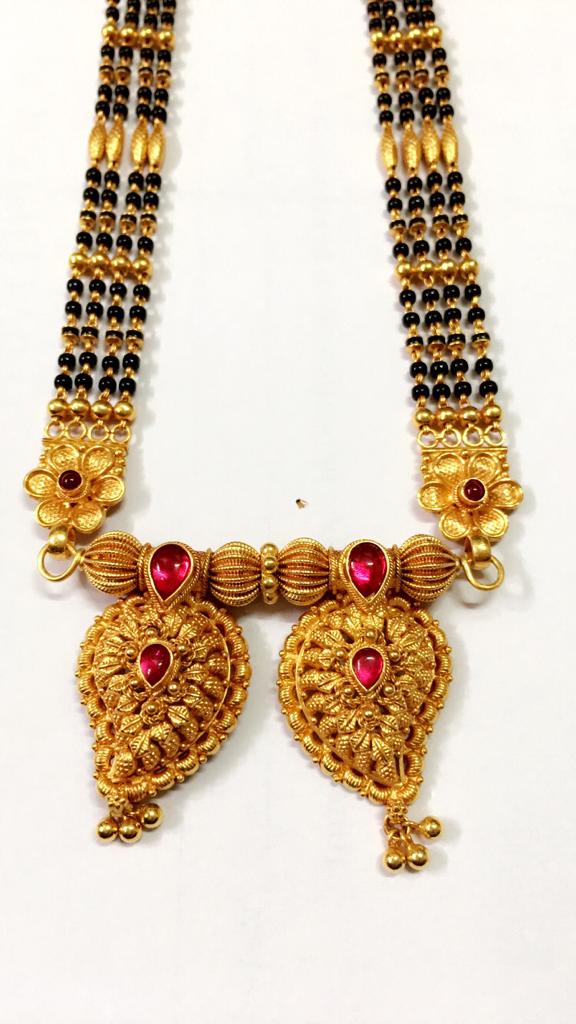
In many traditions, the Mangalsutra is believed to protect the husband and the marriage from the 'evil eye' (Drishti) and negative energies. It is thought to act as a spiritual shield, anchored by the sacred black beads (Karimani) which are believed to absorb and neutralize negativity. The gold used in the necklace represents the purity of the relationship and the enduring nature of the bond, while the thread or chain represents the continuous flow of life and devotion.
To a newcomer, understanding the Mangalsutra requires looking beyond the aesthetic beauty of the gold and beads. It is a living symbol of dharma (duty), artha (prosperity), kama (desire), and moksha (liberation) within the context of a household. It is a constant reminder of the vows taken in the presence of Agni (the fire god), serving as a physical manifestation of a spiritual covenant that is intended to last for lifetimes.
Significance
From an astrological perspective, the combination of gold and black beads is believed to harmonize the influences of various planets. Gold is associated with Jupiter (Guru), which brings wisdom and prosperity, while the black beads are thought to mitigate the ill effects of Rahu and Ketu, which can often cause turbulence in relationships. This celestial balancing act is intended to ensure the longevity and stability of the marriage, allowing the couple to navigate the ebbs and flows of life with spiritual resilience.
Culturally, the Mangalsutra serves as a symbol of the woman's transition into the role of a householder (Grihastha). It is a mark of respect and a testament to her dignity and status within the community. In many Indian societies, the presence of the Mangalsutra is a non-verbal communication of a woman's commitment to her social and familial responsibilities. It is a garment of honor that she wears with pride, representing her identity as a partner in a sacred journey.
Furthermore, the significance extends to the concept of 'Saubhagya' (marital bliss and good fortune). A woman wearing a Mangalsutra is seen as a vessel of auspiciousness for her husband and children. The ritual of 'Mangalya Dharanam' (tying the Mangalsutra) during the wedding is considered one of the most pivotal moments, as it is the point where the two individuals are spiritually tethered. This connection is believed to facilitate the fulfillment of 'Dharma' (righteousness) within the family unit, providing a stable foundation for the next generation.
Auspicious Time
Find your exact auspicious time Check the shubh muhurat and choghadiya for your city and date.
Required Samagri (Materials)
Preparation Steps
- 1Consult a qualified Pandit to find an auspicious Muhurta for the wedding ceremony.
- 2Ensure the Mangalsutra is prepared according to family tradition (some require specific gold purity or bead patterns).
- 3Purify the wedding venue with Ganga Jal (holy water) and incense.
- 4Arrange all ritual items (Samagri) in a clean, dedicated space near the Mandap.
- 5The groom should be prepared for the Mangalya Dharanam ritual, often involving a bath and wearing sacred garments.
Ritual Steps
- 1The Agni Hotra (fire ritual) is initiated, with the couple seated before the sacred fire.
- 2The priest chants Vedic mantras to invoke the deities, specifically seeking blessings for the union.
- 3The Groom prepares to tie the Mangalsutra, often by applying Kumkum and Akshata to the beads.
- 4As the Groom ties the Mangalsutra around the Bride's neck, the priest recites the Mangalya Mantra.
- 5The Bride and Groom may exchange garlands (Varmala) or perform other rituals immediately following this to signify mutual acceptance.
- 6The entire family offers blessings (Ashirwad) to the couple, symbolizing the community's acceptance of the union.
Mantras
Mangalya Dharanam Mantra
मांगल्यं तन्तु ननन्ते, मङ्गलं ब्रूहि मङ्गलम्।
Maangalyam tantu nanante, mangalam bruhi mangalam.
Meaning: May this auspicious thread never break; let there be auspiciousness, let there be only auspiciousness.
Marriage Blessing Mantra
ॐ सौभाग्यवती भव।
Om Saubhagya-vati Bhava.
Meaning: May you be blessed with eternal marital bliss and good fortune.
Do's
- ✓Ensure the Mangalsutra is kept clean and free from dirt.
- ✓Handle the Mangalsutra with respect as it is a sacred object.
- ✓If the thread breaks, it should be repaired or replaced as soon as possible following traditional guidance.
- ✓Use high-quality gold and genuine black beads for spiritual efficacy.
Don'ts
- ✗Do not treat the Mangalsutra as mere fashion jewelry.
- ✗Avoid letting the Mangalsutra touch the floor or unhygienic surfaces.
- ✗Do not wear a damaged or broken Mangalsutra without seeking ritual purification or replacement.
- ✗Do not discard a Mangalsutra disrespectfully; it should be immersed in water or kept safely.
Common Mistakes to Avoid
- •Buying a Mangalsutra solely based on modern design without considering traditional bead requirements.
- •Neglecting the spiritual importance and treating it only as a social status symbol.
- •Not performing the necessary purification rituals if the necklace is handled by others.
Regional Variations
- •South India (Tamil Nadu/Karnataka): Often features heavy gold designs like the 'Thali' or 'Thaali'.
- •Maharashtra: Characterized by the 'Tanmaniya' style with distinct black beads and gold pendants.
- •Bengal: Known as the 'Mangalsutra' or 'Sita Haar', often featuring intricate gold work.
- •North India: Often follows a more modern aesthetic, sometimes resembling a long necklace with black beads integrated into the chain.
Frequently Asked Questions
Can a woman wear a Mangalsutra every day?▾
What should I do if my Mangalsutra breaks?▾
Is the design of the Mangalsutra the same everywhere in India?▾
Popular Tools
References & Traditional Notes
- •Customs vary by region, family tradition, sampradaya, and guru lineage.
- •The use of black beads is specifically aimed at neutralizing Rahu's energy in Vedic astrology.
- •Gold is chosen for its 'Sattvic' (pure) properties.
Related Audio & Bhajans
Love Marriage
Mangalsutra Sacred Necklace Hindu Marriage Shakti / Goddess Parvati sanskar
Affiliate disclosure: Sanatan Hindu participates in the Amazon Associates Programme and the CueLinks affiliate network (Myntra & Flipkart). This page contains affiliate links, if you click and buy, we earn a small commission at no extra cost to you. As an Amazon Associate we earn from qualifying purchases. Full disclosure.
Shop Samagri on Amazon.in
Clicking opens Amazon.in. Prices and availability may vary.
Browse all pooja itemsAmazon Associates tag: geekydevelope-21
Shop Pooja & Festive Essentials on Flipkart
Clicking opens Flipkart via our affiliate link. Prices and availability may vary.
Shop on FlipkartCueLinks Publisher: 300371
Shop Festive Wear on Myntra
Clicking opens Myntra via our affiliate link. Prices and availability may vary.
CueLinks Publisher: 300371
Need a website? Describe it, and AI builds it.
Perfect for a temple, pooja service, astrology practice or small shop. Tell the AI what you want — or drag and drop the classic way — and go live on your own web address in minutes with Sitova. Hosting, SEO, forms and analytics are all included.
- Build with AI or drag & drop
- Your domain + SEO built in
- Free forever plan
Opens sitova.site