
Bhairava: The Fierce Manifestation of Shiva and the Wisdom of the Ashtabhairavas
Explore the profound essence of Lord Bhairava, the fierce manifestation of Shiva, and the divine significance of the Eight Bhairavas (Ashtabhairavas).
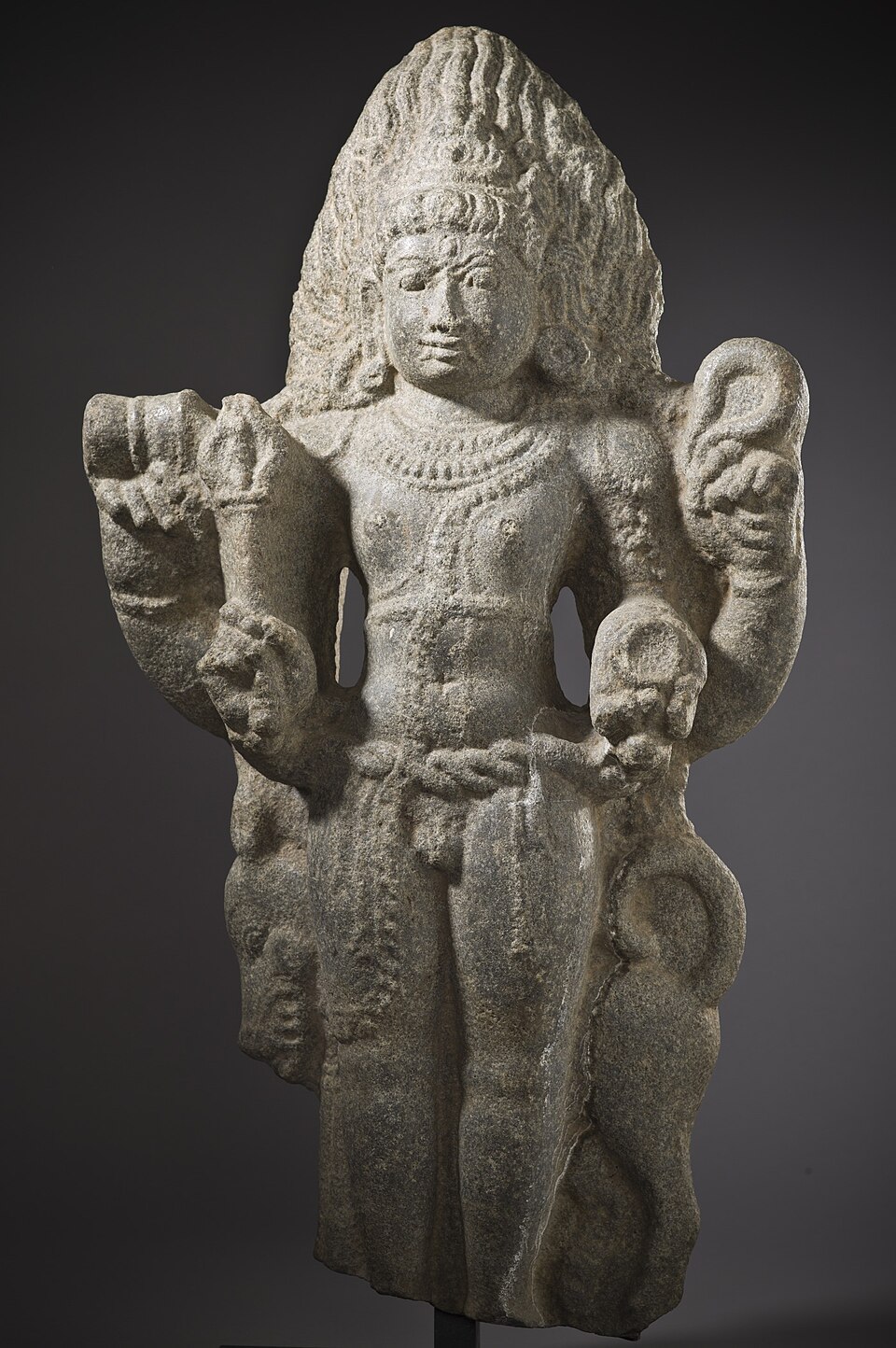
Introduction
The Puranic origins of Bhairava are deeply rooted in the stories of Shiva's cosmic functions. One of the most prominent legends involves the destruction of Brahma's ego. According to the Shiva Purana, when Brahma, the Creator, became prideful regarding his supremacy, Lord Shiva manifested as Bhairava to humble him. In this fierce form, Bhairava severed Brahma's fifth head, symbolizing the destruction of the intellect's attachment to ego and false perception. This act was not one of mere violence, but of profound spiritual correction, demonstrating that even the highest cosmic functions are subject to the ultimate reality of Shiva.
Bhairava is also intrinsically linked to the concept of 'Kala' or Time. As Kaala Bhairava, he is the Lord of Time, the one who transcends the cycles of birth and death and controls the movement of the universe. He is often depicted with a dog as his vahana (vehicle), a symbol of loyalty, protection, and the watchful eye that guards the boundaries between the sacred and the profane. His presence is felt in the most intense moments of life—in the destruction that precedes creation and in the terrifying truth of mortality that drives a seeker toward the eternal.
Beyond the singular form, the tradition recognizes the Ashtabhairavas—the Eight Bhairavas. These are eight distinct manifestations of Bhairava, each presiding over different aspects of the cosmos, different directions, and different psychological states. They represent a complete spectrum of divine protection and cosmic regulation. Understanding Bhairava requires moving beyond the initial fear of his appearance to recognize the compassion inherent in his ferocity; he destroys only that which prevents the soul from achieving Moksha (liberation).
Significance
In the context of Time (Kala), Bhairava's significance is unparalleled. As the master of the temporal dimension, he helps devotees navigate the complexities of karma and the inevitability of change. Worshiping Kaala Bhairava is believed to grant mastery over time, helping one to use their life more purposefully and to transcend the anxiety caused by the passage of years. He is often invoked to remove obstacles caused by 'Kala Dosha' (afflictions related to time or planetary positions), particularly those involving Saturn or Rahu.
Culturally and ritually, Bhairava serves as the 'Kshetrapala' or the guardian deity of sacred spaces. In many ancient cities, such as Kashi (Varanasi), Bhairava is considered the 'Kotwal' (Chief Officer/Protector) of the city. No pilgrimage to Kashi is considered complete without seeking the permission and blessings of Kaala Bhairava. This relationship highlights the belief that the divine presence permeates every inch of sacred geography, and Bhairava is the active force that ensures the sanctity of these spaces is maintained.
Astrologically, Bhairava is invoked to mitigate the heavy karmic influences of planets that cause suffering. His fierce energy acts as a shield, absorbing and neutralizing negative energies that might otherwise afflict a devotee. The worship of the Ashtabhairavas provides a holistic framework for spiritual protection, as each of the eight forms guards a specific direction (Dik) and governs specific elemental and cosmic forces, ensuring that the devotee is protected from all sides of existence.
Best Time to Recite
Find your exact auspicious time Check the shubh muhurat and choghadiya for your city and date.
How to Recite
- 1Achaman: Sip water three times while chanting names of Vishnu to purify the internal self.
- 2Sankalpa: Take water and rice in your palm and state your intention for the puja (e.g., for protection, removal of obstacles, or spiritual growth).
- 3Deepa Prajvalan: Light the oil lamp to invoke the presence of the divine light.
- 4Dhyana: Meditate on the fierce form of Bhairava, visualizing his power and his role as the protector.
- 5Abhisheka: If using a Shiva Lingam or an idol, perform a ritual bath with water, milk, or honey, depending on your lineage's custom.
- 6Offering: Apply sandalwood paste and offer red hibiscus flowers and black mustard seeds.
- 7Arati: Perform the arati with a camphor lamp while ringing the bell.
- 8Pradakshina: Circumambulate the deity or the puja space three times.
- 9Shanti Path: Conclude with prayers for peace and universal well-being.
Mantras
Bhairava Moola Mantra
ॐ ह्रीं बटुक्ाय आपदुद्धारणाय कुरु कुरु बटुक्ाय ह्रीं ॐ
Om Hreem Batukaya Aapaduddharanaya Kuru Kuru Batukaya Hreem Om
Meaning: Om, I bow to the young Bhairava (Batuk Bhairava), the remover of all calamities; may he swiftly remove my obstacles and protect me.
Kaala Bhairava Gayatri Mantra
ॐ कालभैरवाय विद्महे मृत्युञ्जयाय धीमहि तन्नो भैरवः प्रचोदयात्
Om Kaala Bhairavaya Vidmahe Mrityunjayaya Dhimahi Tanno Bhairavah Prachodayat
Meaning: Om, let us meditate on Kaala Bhairava, the conqueror of death. May that Bhairava illuminate our intellect and guide us.
Do's
Don'ts
- ✗Do not perform Bhairava puja in a state of anger or agitation.
- ✗Avoid using bright, 'soft' colors like light pink or sky blue for offerings; stick to deep reds, blacks, or dark tones.
- ✗Do not interrupt the ritual once it has begun.
- ✗Do not neglect the importance of mental purity; external rituals are ineffective without internal discipline.
Common Mistakes to Avoid
- •Misunderstanding Bhairava as a 'dark' or 'evil' deity rather than a transformative force.
- •Performing intense Tantric mantras without proper initiation (Diksha) from a Guru.
- •Focusing only on the 'fear' aspect and ignoring the 'protection and grace' aspect.
- •Mixing Sattvic and Tamasic rituals without understanding the underlying Sampradaya.
Frequently Asked Questions
Is it safe to worship Bhairava without a Guru?▾
What is the difference between Bhairava and Kaala Bhairava?▾
Why is a dog associated with Bhairava?▾
Popular Tools
References & Traditional Notes
- •The Ashtabhairava Upanishad provides deep philosophical insights into the eight forms.
- •The Shiva Purana contains the primary legends regarding the manifestation of Bhairava.
- •Customs regarding offerings (like meat or alcohol) vary significantly between Vedic/Sattvic traditions and Tantric/Tamasic traditions; always follow your lineage.
Related Audio & Bhajans
Om Namah Shivay Dhun
Shiva Stotras and Mantras
Allahabad Prayagraj Triveni Sangam Kumbh Lord Shiva, Lord Krishna, Goddess Saraswati pilgrimage
Maha Shivaratri
Maha Shivaratri 20
Shop Pooja & Festive Essentials on Flipkart
Clicking opens Flipkart via our affiliate link. Prices and availability may vary.
Shop on FlipkartCueLinks Publisher: 300371
Shop Festive Wear on Myntra
Clicking opens Myntra via our affiliate link. Prices and availability may vary.
CueLinks Publisher: 300371
Need a website? Describe it, and AI builds it.
Perfect for a temple, pooja service, astrology practice or small shop. Tell the AI what you want — or drag and drop the classic way — and go live on your own web address in minutes with Sitova. Hosting, SEO, forms and analytics are all included.
- Build with AI or drag & drop
- Your domain + SEO built in
- Free forever plan
Opens sitova.site