
Mehndi Tradition — Significance of Henna in Hindu Weddings
Explore the deep spiritual, cultural, and astrological significance of mehndi in Hindu weddings, including rituals, mantras, regional variations, and traditional practices.
Affiliate disclosure: Sanatan Hindu participates in the Amazon Associates Programme and the CueLinks affiliate network (Myntra & Flipkart). This page contains affiliate links, if you click and buy, we earn a small commission at no extra cost to you. As an Amazon Associate we earn from qualifying purchases. Full disclosure.
Introduction
Significance
Auspicious Time
Find your exact auspicious time Check the shubh muhurat and choghadiya for your city and date.
Required Samagri (Materials)
Preparation Steps
- 1Consult family pandit to determine auspicious muhurta for mehndi application based on bride's janma nakshatra and wedding lagna
- 2Source fresh, chemical-free henna powder from trusted supplier; avoid 'black henna' containing PPD
- 3Sift henna powder through fine muslin cloth to remove impurities and coarse particles
- 4Prepare henna paste 12-24 hours before application: mix powder with lemon juice, sugar, essential oils, and water to smooth, yogurt-like consistency
- 5Cover bowl with cling film and let rest in warm place (25-30°C) for dye release (termed 'terpene activation')
- 6Test paste on small skin patch to check for allergic reactions and stain quality
- 7Clean and exfoliate bride's hands and feet thoroughly with mild soap; avoid moisturizers
- 8Set up mehndi area with good lighting, comfortable seating, and all samagri arranged
- 9Perform preliminary Ganesha pūjā and invoke blessings of family deities (kuladevatā)
- 10Arrange for experienced mehndi artist(s) familiar with traditional motifs and family customs
Ritual Steps
- 1Begin with sankalpa: bride sits facing east or north; pandit or elder performs ghaṭasthāpana with kalaśa, coconut, mango leaves
- 2Offer pūjā to henna powder/cones: apply tilak of kumkum and haldi, offer akṣata, flowers, dhoop, dīpa; chant Ganesha mantra
- 3Elder married women (sumangalīs) apply first dot of mehndi on bride's palm as śagun — typically a bindu or small circle
- 4Mehndi artist begins application starting with right hand (considered more auspicious), then left hand, then feet
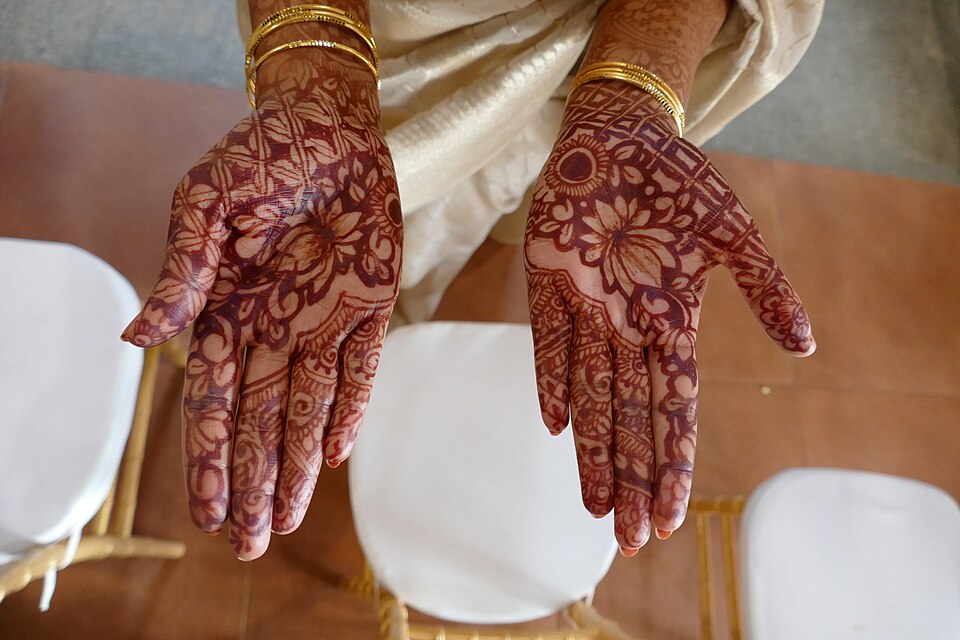
- 5Traditional motifs applied: peacock (mayūra — beauty, grace), lotus (kamala — purity, Lakṣmī), paisley (kairī — fertility), mandala (cosmic order), kalash (abundance), swastika (auspiciousness), bride-groom figures (dulha-dulhan)
- 6Bride's initials or groom's name hidden in design (customary game for wedding night discovery)
- 7Application continues for 3-6 hours depending on complexity; bride must keep limbs still
- 8After paste dries (30-60 mins), apply lemon-sugar sealant (1:1 lemon juice:sugar) with cotton ball to enhance stain
- 9Wrap hands/feet with medical tape or cotton cloth; traditionally, bride sleeps with wrapped mehndi overnight
- 10Next morning, gently scrape off dried paste (never wash with water immediately); apply warm clove smoke (laung dhūpa) over hands
- 11Apply coconut/mustard oil generously; avoid water contact for 12-24 hours for optimal oxidation and darkening
- 12Distribute mehndi-filled cones or small boxes as prasāda to guests; share sweets
- 13Conclude with āratī of bride by sumangalīs, singing traditional mehndi geet (folk songs)
Mantras
Ganesha Mantra for Auspicious Beginning
ॐ गण गणपतये नमः
Om Gaṃ Gaṇapataye Namaḥ
Meaning: Salutations to Lord Ganesha, the remover of obstacles, for a smooth and blessed ceremony.
Mangala Gauri Mantra for Marital Bliss
ॐ मंगल गौर्यै नमः
Om Maṅgala Gāuryai Namaḥ
Meaning: Salutations to Goddess Gauri (Parvati), the bestower of marital happiness and longevity.
Lakshmi Mantra for Prosperity
ॐ श्रीं ह्रीं क्लीं कमलवासिन्यै स्वाहा
Om Śrīṃ Hrīṃ Klīṃ Kamalavāsinyai Svāhā
Meaning: Invocation to Goddess Lakshmi, resident of the lotus, for abundance, beauty, and grace in married life.
Traditional Mehndi Geet (Folk Song Verse)
मेहंदी रचण लागी, दुल्हनिया के हाथ सासू जी ने बुलाया, ननदिया ने गाया मेहंदी रचे गहरी, पिया का प्यार गहरा
Mehndī racana lāgī, dulhaniyā ke hāth Sāsū jī ne bulāyā, nandiyā ne gāyā Mehndī race gaharī, piyā kā pyār gaharā
Meaning: Mehndi is being applied on the bride's hands; mother-in-law calls, sister-in-law sings — may the mehndi stain deep, and the beloved's love be profound.
Do's
- ✓Use only natural, chemical-free henna; verify ingredient list
- ✓Perform patch test 24 hours prior for allergies
- ✓Keep bride warm and comfortable during long application
- ✓Apply lemon-sugar sealant for darker, longer-lasting stain
- ✓Use clove smoke (laung dhūpa) after paste removal — traditional and effective
- ✓Involve elder married women for blessings and first application
- ✓Sing traditional mehndi songs (geet) to create joyous atmosphere
- ✓Document the designs photographically before they fade
- ✓Follow aftercare: oil regularly, avoid water, exfoliation, chlorine
Don'ts
- ✗Do not use 'black henna' or chemical cones containing PPD (para-phenylenediamine) — causes severe allergic reactions
- ✗Do not wash mehndi with soap/water immediately after scraping — wait 12-24 hours
- ✗Do not apply moisturizer, sunscreen, or oil before mehndi application
- ✗Do not let bride do household chores or use hands excessively during drying
- ✗Do not rush the artist; intricate bridal mehndi requires 4-8 hours
- ✗Do not apply mehndi on broken skin, cuts, or rashes
- ✗Do not use hair dryer or direct heat to dry paste — causes cracking
- ✗Do not schedule mehndi on inauspicious days (amavasya, eclipses, family mourning periods)
Common Mistakes to Avoid
- •Using old, expired henna powder resulting in pale orange stain instead of deep red-brown
- •Skipping the 12-24 hour dye-release resting period for paste
- •Applying mehndi on oily or recently moisturized skin — prevents penetration
- •Wrapping too tightly causing paste to smudge or skin irritation
- •Removing paste with water instead of scraping gently
- •Exposing fresh stain to water, steam, or sweat within first 24 hours
- •Choosing overly modern designs that omit traditional auspicious motifs
- •Not consulting pandit for muhurta, leading to application during rāhu kāla or yamaghaṇṭa
- •Forgetting to hide groom's name/initials — misses beloved tradition
- •Neglecting aftercare, causing stain to fade in 3-4 days instead of 1-2 weeks
Regional Variations
- •North India (Punjab, UP, Rajasthan): Elaborate full-hand/foot coverage; heavy use of paisley, peacock, kalash; mehndi night with dholak, giddha, bhangra; groom's name hidden in design
- •Gujarat/Rajasthan (Marwari): Intricate latticework (jaali), mirror-work motifs; mehndi applied to both bride and groom in some communities; 'Mehndi-Sangeet' combined
- •Maharashtra: Simpler, elegant designs; focus on fingertips and central palm; 'Halad-Chandan' ceremony precedes mehndi; green mehndi (with nilgiri) sometimes used
- •South India (Tamil, Telugu, Kannada): 'Marundhu' or 'Mailanchi' — often simpler geometric patterns; applied during 'Nalangu' or 'Pellikuthuru'; turmeric-haldi mixed with mehndi in some traditions
- •Bengal/Odia: 'Mehndi' less central; 'Gaye Holud' (turmeric) takes precedence; if done, minimal designs on palms only; Alta (red dye) used on feet instead of mehndi
- •Sindhi: 'Mehndi' ceremony called 'Mehndi Rat'; groom also applies mehndi on little finger; specific 'Sindhi motifs' including fish (fertility), chakli (wheel)
- •Himachal/Uttarakhand: Pahari designs with floral vines, birds; mehndi applied by sister-in-law (bhabhi); folk songs in Pahari dialect
- •Diaspora (Caribbean, Mauritius, Fiji, UK/US): Fusion designs; glitter mehndi, white henna, colored cones; shorter application times; professional artists vs family
Frequently Asked Questions
Why is mehndi applied before the wedding and not after?▾
What is the significance of hiding the groom's name in the mehndi design?▾
Can widows or divorced women apply mehndi to the bride?▾
Is there a scriptural basis for mehndi in Hindu weddings?▾
How long does bridal mehndi last and how to make it darker?▾
What if the bride has sensitive skin or henna allergy?▾
Popular Tools
References & Traditional Notes
- •Charaka Samhita, Sutrasthana 3.12 — Henna (Madayantika) listed for cooling, wound-healing properties
- •Sushruta Samhita, Chikitsasthana 1.123 — Henna paste for skin diseases, burning sensation
- •Solah Shringar (Sixteen Adornments) — Mehndi listed as 7th adornment in texts like Kama Sutra, Natya Shastra
- •Rajasthani folk epic 'Dhola-Maru' — Detailed description of mehndi ceremony with specific motifs
- •Punjabi 'Mehndi Geet' tradition — Oral songs passed through generations, documented by folklorists
- •Grihya Sutras (Ashvalayana, Paraskara) — Pre-wedding rituals for bride purification, adornment
- •Manusmriti 9.28 — Importance of adorning bride for marital harmony (contextual reference)
- •Regional texts: 'Mangal Geet' (Braj), 'Vivah Geet' (Awadhi), 'Pelli Geetalu' (Telugu) — Contain mehndi references
- •Ayurvedic pharmacopeia — Lawsonia inermis (Madayantika) classified as sheetala (cooling), rasa: tikta/kashaya
- •Modern dermatological studies — Lawsone (2-hydroxy-1,4-naphthoquinone) binds keratin, safe for most skin types
Related Audio & Bhajans
Sanatan Hindu Ekta Padyatra Song
Halima Al Balushi ' One Traditional Oman. How Customs Differ Throughout The Sultanate
Affiliate disclosure: Sanatan Hindu participates in the Amazon Associates Programme and the CueLinks affiliate network (Myntra & Flipkart). This page contains affiliate links, if you click and buy, we earn a small commission at no extra cost to you. As an Amazon Associate we earn from qualifying purchases. Full disclosure.
Shop Samagri on Amazon.in
Clicking opens Amazon.in. Prices and availability may vary.
Browse all pooja itemsAmazon Associates tag: geekydevelope-21
Shop Pooja & Festive Essentials on Flipkart
Clicking opens Flipkart via our affiliate link. Prices and availability may vary.
Shop on FlipkartCueLinks Publisher: 300371
Shop Festive Wear on Myntra
Clicking opens Myntra via our affiliate link. Prices and availability may vary.
CueLinks Publisher: 300371
Need a website? Describe it, and AI builds it.
Perfect for a temple, pooja service, astrology practice or small shop. Tell the AI what you want — or drag and drop the classic way — and go live on your own web address in minutes with Sitova. Hosting, SEO, forms and analytics are all included.
- Build with AI or drag & drop
- Your domain + SEO built in
- Free forever plan
Opens sitova.site