Sacred Texts & ScripturesSoma (associated with the nectarthe Saman)None specifically, but integral to all major Vedic Yajnas

Samaveda — The Veda of Music and Melodies: A Comprehensive Guide

Explore the Samaveda, the divine Veda of melodies and musical chants. Learn about its origins, spiritual significance, and its role in Vedic chanting.
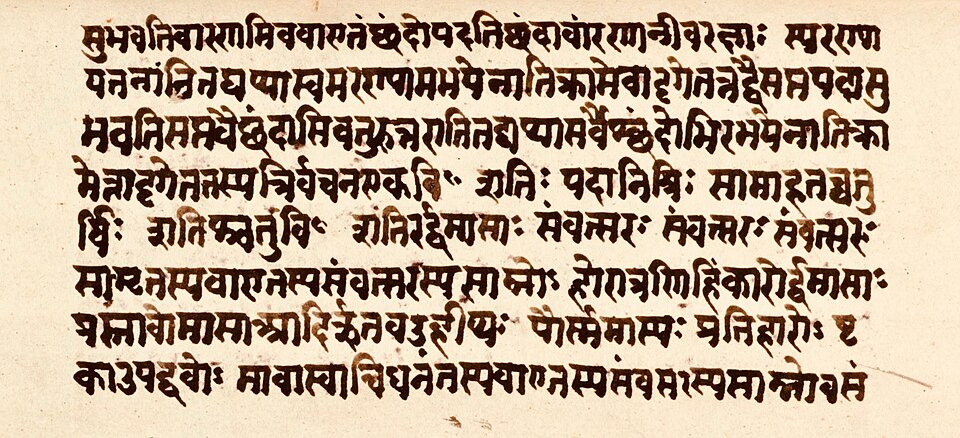
By Sanatan Hindu5 min readUpdated 18 August 2026Audio available
Share:
Samaveda — The Veda of Music and Melodies: A Comprehensive Guide

यह लेख अभी अंग्रेज़ी में उपलब्ध है। हिंदी अनुवाद के लिए नीचे बटन दबाएँ।

Introduction

The Samaveda Samhita stands as one of the four foundational pillars of Hindu scripture, representing the melodic and musical essence of the Vedic tradition. While the Rigveda provides the sacred verses (mantras), the Samaveda provides the musical notation and the rhythmic arrangement required to chant those verses with divine resonance. It is often described as the 'Veda of Melodies' (Saman), where the focus shifts from the mere meaning of words to the vibration, pitch, and cadence of the sound itself. In the Vedic worldview, sound (Shabda) is not merely a medium of communication but a manifestation of the Divine, and the Samaveda is the most refined tool for tapping into these cosmic vibrations.
Originating in the ancient Vedic period, the Samaveda is intricately linked to the Sama Chants, which were used by the Udgatr priests during the elaborate Yajnas (sacrificial rituals). These priests would chant these melodies to invoke the presence of deities, ensuring that the offering reached the heavens through the medium of beautiful, structured sound. The text is not a separate collection of entirely new ideas, but rather a compilation of verses largely drawn from the Rigveda, reorganized and set to specific musical scales known as Samans. This transformation from spoken word to musical melody represents the evolution of spiritual practice from simple recitation to a sophisticated art form.
Legend and tradition suggest that the science of music (Gandharva Veda) finds its roots in the Samaveda. It is believed that the rhythms and melodies within this Veda are cosmic in nature, mirroring the patterns of the universe. Through the Samaveda, the human voice is trained to reach certain frequencies that resonate with the subtle bodies of the practitioner. It is more than a book; it is a living oral tradition that has been preserved through rigorous mnemonic techniques passed down from guru to shishya for millennia.
In the broader spiritual context, the Samaveda teaches us that the path to the Divine is not only through intellect or action but also through devotion (Bhakti) expressed via sound. It bridges the gap between the physical ritual and the emotional experience of the practitioner. By studying the Samaveda, one understands that the vibration of a mantra is just as crucial as its meaning, laying the groundwork for the complex systems of Indian Classical Music that continue to thrive today.

Significance

The significance of the Samaveda is multifaceted, spanning spiritual, scientific, and cultural dimensions. Spiritually, it is considered the source of Nada Brahma—the concept that the entire universe is composed of sound. By chanting Saman melodies, the practitioner aims to align their internal energy with the cosmic rhythm. The fruits (phala) of studying and chanting the Samaveda are profound, ranging from mental clarity and emotional stability to a deep, meditative state of consciousness. It is believed that the correct application of Saman chanting can purify the subtle channels (nadis) of the body, facilitating a smoother flow of Prana (life force).
Culturally, the Samaveda is the progenitor of the Indian musical system. The concepts of Svaras (notes), Ragas (melodic frameworks), and Talas (rhythmic cycles) find their most ancient expressions in the Saman chants. The mathematical precision required to chant these melodies laid the foundation for the complex structures found in Hindustani and Carnatic classical music. It represents the intersection of art and spirituality, where aesthetic beauty is utilized as a vehicle for transcendental realization.
Religiously, the Samaveda holds a primary position in the ritualistic aspects of Vedic sacrifice. Without the melodic chanting of the Samaveda, many Vedic rituals would be considered incomplete, as the 'musicality' is thought to be the 'nectar' that makes the offerings pleasing to the Devas. It provides the vibrational 'carrier wave' for the mantras of the Rigveda. In many traditions, the Samaveda is viewed as the essence of the other Vedas, containing the emotional and devotional core that makes the rituals come alive.
Furthermore, the Samaveda emphasizes the importance of 'Samyukta' (union) through sound. It teaches that through disciplined practice of melody, one can achieve a state of 'Ekagrata' (one-pointedness), which is essential for all forms of Sadhana. Whether in the context of a grand Yajna or a personal meditation, the principles of the Samaveda guide the practitioner toward a deeper resonance with the Divine presence.

Best Time to Recite

While Saman chanting can be practiced at any time for meditation, it is traditionally most potent during the 'Brahma Muhurta' (approx. 1.5 hours before sunrise) when the cosmic vibrations are most subtle and receptive.

Find your exact auspicious time Check the shubh muhurat and choghadiya for your city and date.

How to Recite

  1. 1Achamana: Take small sips of water to purify the internal self.
  2. 2Sankalpa: State your intention for the practice (e.g., for peace, for spiritual growth, or for honoring the Vedas).
  3. 3Guru Vandana: Offer a mental or spoken salutation to your Guru and the lineage of Vedic scholars.
  4. 4Invocation: Invoke the deities mentioned in the Saman chants, focusing on their vibrational essence.
  5. 5Saman Chanting: Begin the melodic recitation. Focus on the 'Svaras' (notes) and the precise movement of the voice as prescribed in the Saman tradition.
  6. 6Meditation: After the chanting, sit in silence for several minutes to absorb the residual vibrations.
  7. 7Shanti Path: Conclude with a prayer for universal peace.

Mantras

Vedic Shanti Mantra

ॐ पूर्णमदः पूर्णमिदं पूर्णात्पूर्णमुदच्यते ।

Om Purnamadah Purnamidam Purnat Purnam Udachyate

Meaning: That is whole, this is whole; from the whole, the whole becomes manifest.

Gayatri Mantra (Melodic context)

ॐ भूर्भुवः स्वः तत्सवितुर्वरेण्यं भर्गो देवस्य धीमहि धियो यो नः प्रचोदयात् ॥

Om Bhur Bhuvah Svah Tat Savitur Varenyam Bhargo Devasya Dhimahi Dhiyo Yo Nah Prachodayat

Meaning: We meditate on the glory of that Being who has produced this universe; may He enlighten our minds.

Do's

  • Focus deeply on the correct pitch (Svara) and rhythm (Laya).
  • Maintain a straight spine to allow unobstructed flow of Prana.
  • Respect the oral tradition by attempting to replicate the sounds as heard from a Guru.
  • Use the breath to sustain the melodic phrases.

Don'ts

  • Do not chant with a rushed or hurried tempo.
  • Do not perform the chanting in a distracted or disrespectful state of mind.
  • Do not ignore the precise phonetic nuances (Ucharana) of the Sanskrit syllables.
  • Avoid chanting in an area with significant noise or chaotic energy.

Common Mistakes to Avoid

  • Focusing only on the meaning and ignoring the musical vibration.
  • Incorrect breath control, leading to broken melodies.
  • Treating the Saman as mere singing rather than a sacred ritualistic act.
  • Neglecting the importance of the 'Svara' (musical notes) in the recitation.

Frequently Asked Questions

What is the difference between Rigveda and Samaveda?
The Rigveda consists of the raw hymns (mantras), whereas the Samaveda takes those hymns and arranges them into musical melodies (Samans) meant for chanting.
Is Samaveda only for musicians?
No. While it is the foundation of music, its spiritual essence is for anyone seeking to connect with the Divine through the power of sacred sound and vibration.
Can I learn Samaveda through books?
While books can provide theoretical knowledge, the Samaveda is an oral tradition. True mastery of its melodies and vibrations is traditionally achieved through guidance from a qualified Guru.

References & Traditional Notes

  • The Samaveda is traditionally taught through the Shravana (listening) and Manana (reflection) methods.
  • Note that the specific musical notation used in the Vedic period differs from modern Western or Indian classical notation.
  • The connection between Samaveda and the concept of 'Nada Yoga' is a key area of study in advanced Vedic science.

Related Audio & Bhajans

Navagraha Pooja Vidhi Comprehensive Worshiping Navagrahas

otherYouTube
Open on YouTube →
Lyrics

Rath Yatra Special 2023 রথযাত্রা স্পেশাল ননস্টপ Odia Jagannath Bhajan SB Popular Music( MP 3 160 K)

other
View Lyrics

Dvaita Vedanta Madhvacharya's Dualistic Philosophy Lord Narasimha

otherYouTube
Open on YouTube →
Lyrics

40 Aspects Of Veda And Vedic Literature In The Human Physiology 01

other
View Lyrics

Ancient Medicine Today : Ayurveda and Panchakarma

other
View Lyrics

Hanuman Chalisa (From "Hanuman Chalisa - Zee Music Devotional")

otherSanjeev-Ajay
View Lyrics

Ayurveda

otherSpa Music Collective
View Lyrics

Ayurveda and wellness

otherYouTube
Open on YouTube →
Lyrics

Harmony, Wellness and Music

otherWellness Adult
View Lyrics

Vedanta

otherClaudio Solis
View Lyrics

फ्लिपकार्ट पर पूजा और त्योहारी सामग्री खरीदें

क्लिक करने पर हमारे एफ़िलिएट लिंक से फ्लिपकार्ट खुलता है। कीमत और उपलब्धता बदल सकती है।

फ्लिपकार्ट पर खरीदें

CueLinks प्रकाशक: 300371

मिंत्रा पर त्योहारी परिधान खरीदें

क्लिक करने पर हमारे एफ़िलिएट लिंक से मिंत्रा खुलता है। कीमत और उपलब्धता बदल सकती है।

CueLinks प्रकाशक: 300371

Share:

दैनिक पंचांग व त्योहार अपडेट पाएँ

हमारे निःशुल्क न्यूज़लेटर से जुड़ें, कोई स्पैम नहीं, कभी भी अनसब्सक्राइब करें।